The intellectual discourse in South Asia regarding the tragedy of Karbala has undergone a significant evolution over the past two centuries. While early Islamic historical texts often documented events with a focus on political outcomes, modern South Asian intellectuals have developed a robust, moral-centric framework that has become a defining characteristic of contemporary discourse on the subject.
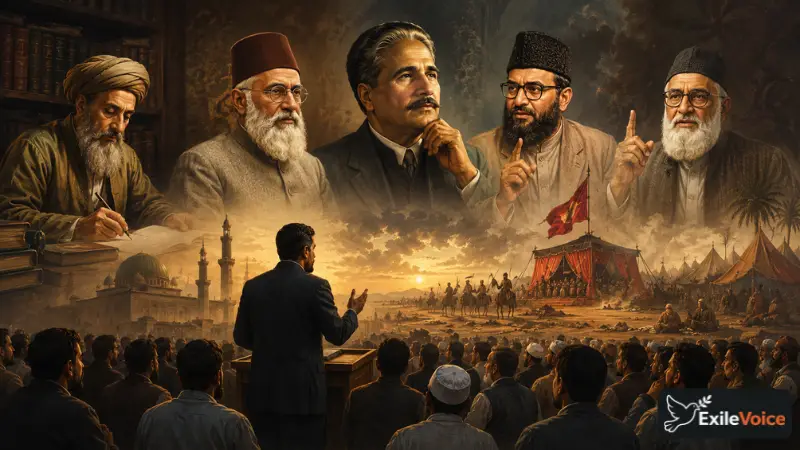
The foundation of this shift was laid in the 18th and 19th centuries by figures like Shah Waliullah and Shibli Nomani. They began to synthesize historical facts with a deeper theological focus, moving away from purely descriptive narratives. This approach was further refined and popularized by the "Poet of the East," Allama Iqbal, in the 20th century. Iqbal elevated the martyrdom of Imam Hussain to a universal symbol, positioning his struggle as a pivotal turning point in human history against the rise of absolutism and hereditary rule.
This framework was subsequently expanded and politicized by 20th-century intellectuals such as Maulana Maududi and Dr. Israr Ahmed. They framed the conflict not just as a historical event, but as a struggle against the distortion of the original spirit of Islam, which they argued was fundamentally democratic and consensus-based. This perspective has resonated deeply in South Asian public discourse, serving as a counter-narrative to secular or purely political interpretations that might otherwise reduce the events of the 7th century to mere power struggles.
The significance of this evolution is profound. By framing Karbala through the lens of ethical resistance, these intellectuals provided a language for modern Muslims to discuss governance, justice, and the morality of leadership. It allows for a critical evaluation of Islamic history that transcends the mere admiration of imperial expansion, forcing a focus on the ethical consistency of leaders and the preservation of Islamic values throughout the centuries. Today, this tradition continues to influence public debate, as scholars and speakers utilize this narrative to bridge the gap between historical analysis and contemporary social critique.