The landscape of modern warfare in the Middle East is shifting from traditional state-on-state engagements to a complex web of "ghost bases," unconventional naval tactics, and technological reverse-engineering. Recent investigative reports, notably from the Wall Street Journal, have shed light on the existence of a clandestine Israeli military installation located deep within the Iraqi desert. This "make-shift" base, established without the knowledge of the Iraqi government, serves as a strategic contingency hub designed to provide immediate support and recovery for aerial operations over Iran.
The sophistication of this deployment, facilitated by high-altitude parachute drops of heavy machinery and tanks, highlights a significant gap in regional surveillance. Remarkably, even global powers like Russia and China, despite their advanced satellite monitoring capabilities, reportedly failed to detect or share information regarding this facility until Iraqi ground forces stumbled upon it. The resulting skirmish between Iraqi troops and the base's automated or rapid-response defenses underscores the volatility of territorial sovereignty in a region where boundaries are increasingly bypassed by high-tech military hardware.
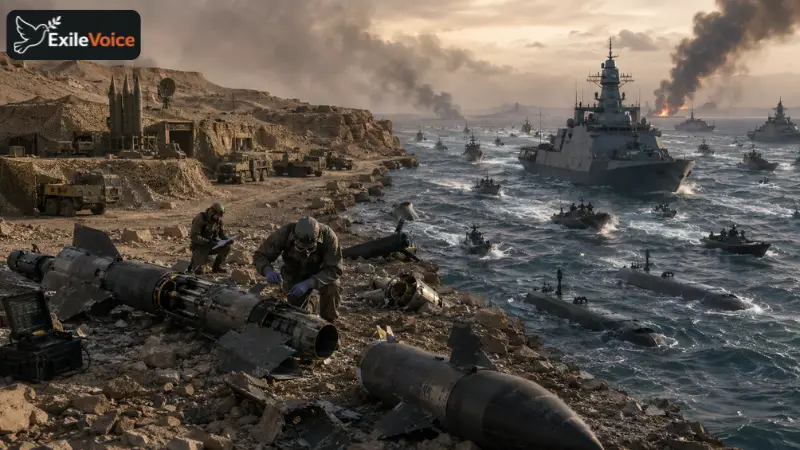
Simultaneously, the failure of advanced munitions during recent exchanges has provided Iran with a technological windfall. Reports indicate that approximately 185 unexploded missiles, a mix of high-precision American and Israeli technology, have fallen into Iranian hands. For a nation already proficient in missile development, this represents a massive opportunity for reverse-engineering. By deconstructing these sophisticated guidance systems and propulsion units, Iran stands to close the technological gap with Western-aligned forces significantly.
Furthermore, Iran’s maritime strategy in the Strait of Hormuz demonstrates a pivot toward "asymmetric saturation." Rather than fielding a conventional navy to face American carrier groups, Tehran has deployed hundreds of "fast boats", small, highly maneuverable craft capable of swarming larger vessels. When paired with bus-sized mini-submarines armed with cruise missiles and a dense network of naval mines, these tactics create a "mating of mosquitoes" effect that can overwhelm even the most advanced Aegis-class defense systems. This shift suggests that the future of regional conflict will not be won through sheer tonnage, but through the cost-effective application of swarming technologies and the exploitation of captured enemy intelligence.