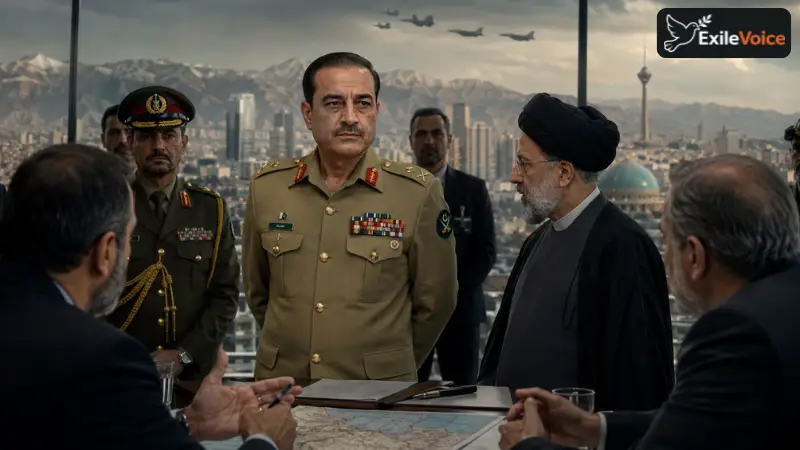
Amid escalating geopolitical tensions in the Middle East, Pakistan's Chief of Army Staff, General Asim Munir, has embarked on a critical, high-stakes diplomatic mission to Tehran. This strategic visit unfolds at a perilous juncture as the United States, under the direction of President Donald Trump, visibly signals preparations for a fresh wave of military operations and potential airstrikes targeting Iranian infrastructure. The gravity of the regional standoff is underscored by dramatic physical indicators on the ground: the immediate clearing of civilian airspaces over Iran and the sudden activation of widespread GPS blocking across the region, a technical phenomenon typically preceding major aerial warfare and military sortees.
General Munir's 12-hour presence on the ground in the Iranian capital is not an isolated unilateral gesture, but rather the spearhead of a meticulously coordinated multi-nation regional mediation effort. This diplomatic corridor has been actively supported by key regional stakeholders, including Qatar, Saudi Arabia, Turkey, Egypt, and Oman. Prior to General Munir’s arrival, a series of intense shuttle diplomacy maneuvers were executed by Pakistan’s federal minister, Mohsin Naqvi, who traveled back and forth to Tehran three times within a single week to establish a viable diplomatic runway. Naqvi engaged in critical deliberations with prominent Iranian officials, including President Masoud Pezeshkian, Foreign Minister Abbas Araghchi, Parliamentary Leader Mohammad Bagher Ghalibaf, and the high command of the Islamic Revolutionary Guard Corps (IRGC).
This round of negotiations exhibits a significantly distinct character compared to prior diplomatic attempts. The current strategy is characterized by tightly controlled optics, a deliberate absence of public media celebrations, and heightened operational security, signaling the immense sensitivity of the ongoing conversations. Accompanying General Munir on a separate flight is the Director General of the Inter-Services Intelligence (ISI), Lieutenant General Asim Malik, whose deep institutional ties with Western intelligence systems, particularly the Central Intelligence Agency (CIA), position him as a pivotal structural bridge in these indirect communications.
The primary operational objective of this back-channel diplomacy revolves around a heavily contested draft agreement, or Letter of Intent, acting as a crucial intermediary document between Washington and Tehran. Because direct face-to-face negotiations between the United States and Iran remain politically impossible, Pakistani and Qatari mediators are manually routing drafts back and forth, examining specific paragraphs, language, and legal terms. A major structural hurdle in the current talks is the profound lack of mutual trust. Tehran is steadfastly demanding hard, written security guarantees that any proposed ceasefire or cessation of hostilities will be permanent and binding. Conversely, Washington shows distinct hesitation toward making explicitly written, long-term commitments, preferring flexible terms that preserve strategic options.
The stakes are further elevated by internal political pressures within the United States. Key figures within the Republican legislative leadership have issued direct correspondence to President Trump, explicitly urging him to finish what he started regarding Iranian containment. In response to these looming operational threats, Iran’s leadership has maintained a highly defiant posture. Ayatollah Mojtaba Khamenei issued a comprehensive warning stating that should a fresh wave of external aggression be initiated against Iran, the resulting theater of war will not remain confined to the immediate region but will expand far beyond historical boundaries. This severe warning highlights the existential scale of the current standoff and the immense responsibility resting on the shoulders of the regional mediators working to secure a durable peace.