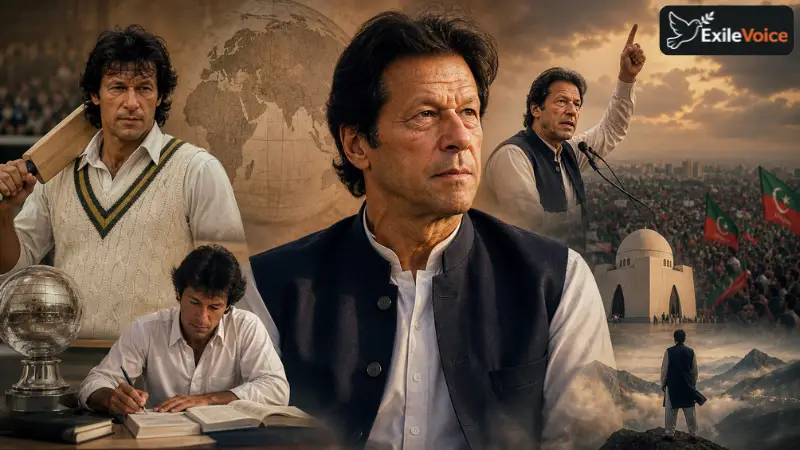
Understanding the current political crisis in Pakistan requires a retrospective look at the foundational principles of its most polarizing figure. Long before his ascent to the Prime Minister's office, Imran Khan’s 1983 autobiography provided a roadmap for his eventual political journey. This early literature reveals a man deeply concerned with the "Third World" struggle and the misallocation of national resources, themes that remain central to his rhetoric today.
In his early writings, Khan expressed a precocious concern regarding the defense budgets of developing nations like India and Pakistan. He argued that the "pressing issues" of home economies and poverty should take precedence over military spending.
This insight is particularly striking given the current friction between his political movement and the established power structures in Pakistan. It suggests that his "anti-establishment" stance is not a recent populist pivot but a long-held conviction dating back to his early thirties.
The article also touches upon the concept of "The Architect of the Possible." While critics often label his approach as arrogant, Khan himself described it as a "determination" to not let institutions be taken over by those who do not have the heart of the cause, whether in cricket or governance .
This refusal to compromise on principles, even at the cost of being misunderstood, is a recurring theme. The analysis compares this trait to historical figures like Mohammad Ali Jinnah, suggesting that Khan views himself more as a "Statesman" than a "Politician." The distinction is crucial: a politician negotiates for the immediate, while a statesman stands on a pedestal of long-term vision .
The narrative further explores Khan’s early activism, such as his refusal to play in South Africa during the Apartheid era despite lucrative offers, choosing instead to uphold moral principles over financial gain .
This historical context provides a necessary lens for international observers to understand why a significant portion of the Pakistani diaspora remains fiercely loyal. His journey is framed not just as a quest for power, but as a continuation of a decades-long philosophy centered on "La Ilaha Illallah", the idea of total freedom from any form of worldly subjugation or "Ghulami".