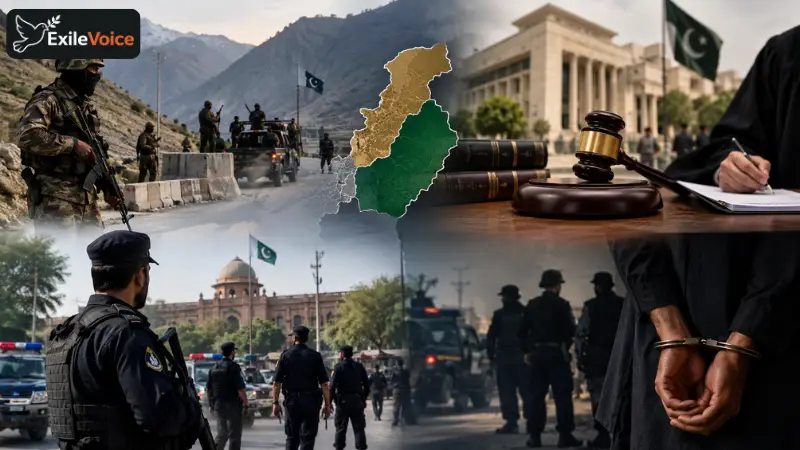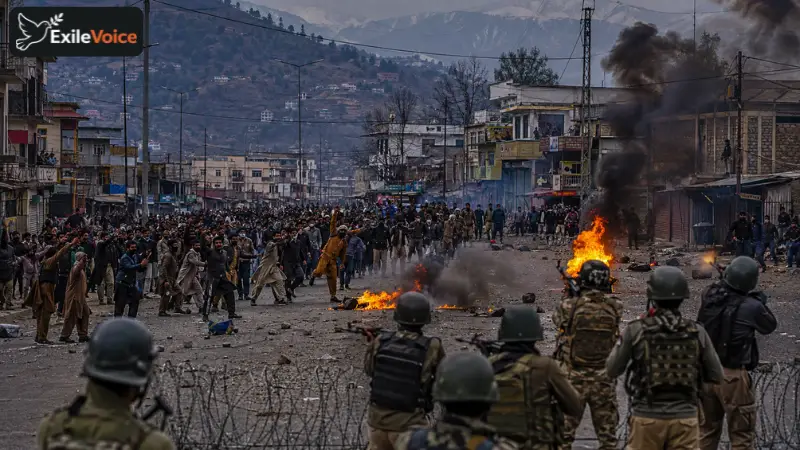
The administrative territory of Azad Jammu and Kashmir has descended into severe civil volatility following intense clashes between security forces and local demonstrators in Rawalakot and surrounding areas. What began as localized public agitation led by the Joint Public Action Committee over socio-economic grievances has escalated into violent encounters, resulting in multiple casualties among both civilian protestors and law enforcement personnel.
Independent sources confirm that direct fire was exchanged in several urban sectors, leaving multiple individuals dead and dozens severely injured. The rapid deterioration of law and order prompted immediate, severe state interventions, including complete regional information blackouts, telecommunication suspensions, and restricted media access. The lack of transparent information flow has heightened local anxieties, with conflicting casualty counts circulating through informal communication networks while official state media maintains a heavily filtered narrative.
The tactical response from law enforcement agencies, including the deployment of paramilitary Rangers, has exacerbated the historical friction between the local population and state authorities. In several districts, systemic gridlock occurred as security personnel attempted to seal off major transit bridges linking Kashmir to mainland Pakistan. This strategy was designed to block a scheduled long-march initiative organized by public committees, but it ultimately resulted in direct containment battles inside crowded market areas. Reports indicate that local crowds retaliated against state measures, leading to the temporary containment of security personnel in decentralized locations.
This escalating confrontation underscores a deep-seated crisis of institutional legitimacy within the territory. State attempts to resolve deep socio-economic and political grievances through administrative force rather than political dialogue have historically proved counterproductive in regions with long traditions of political resistance. Analysts note that treating a highly mobilized population with standard crowd-control measures overlooks the underlying systemic issues regarding local representation, governance autonomy, and civic rights.
The regional judiciary and administrative offices have struggled to maintain a stabilizing presence. Local deputy commissioners have formally requested the implementation of strict curfews to prevent further urban escalation, yet the broader institutional framework remains paralyzed. As public resentment deepens, the long-term prospects for political reconciliation diminish. The situation requires an immediate shift away from security-driven containment toward structured constitutional engagement to avoid a catastrophic breakdown of regional stability.