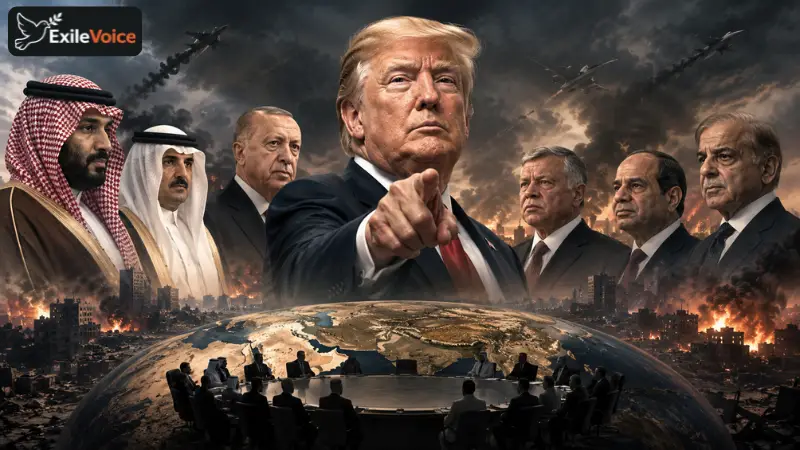
In a stunning geopolitical maneuver that has upended active regional diplomatic tracks, former U.S. President Donald Trump issued an ultimatum directed at the major powers of the Islamic world. Amidst a grinding regional war approaching its 90-day mark, Trump utilized his Truth Social platform to issue what he termed a mandatory request. He declared that any sustainable ceasefire, cessation of hostilities, or permanent de-escalation by Israel is explicitly contingent upon these Muslim-majority nations formally signing the Abraham Accords and recognizing the state of Israel.
The sweeping declaration represents a dramatic intervention in ongoing multilateral negotiations. It directly pressures key regional actors including Saudi Arabia, Qatar, Turkey, Jordan, Egypt, and Pakistan. By shifting the goalposts of current mediation from a conventional operational ceasefire to full diplomatic normalization with Israel, Trump is attempting to weaponize the current conflict to complete his hallmark foreign policy initiative. For nations like Pakistan and Saudi Arabia, this mandate introduces severe domestic and systemic complications, forcing state actors to balance immediate geopolitical security with deeply entrenched ideological positions regarding Palestinian sovereignty.
The timing of this announcement complicates an already delicate series of diplomatic maneuvers. For the past two months, high-ranking regional leaders have engaged in intensive shuttle diplomacy to construct an exit ramp for the current crisis. Pakistani Army Chief General Asim Munir and Prime Minister Shehbaz Sharif have consistently engaged interlocutors in Tehran, Doha, and Riyadh to stabilize the regional security landscape. However, Trump’s explicit linking of a regional peace architecture to the mandatory signing of the Abraham Accords disrupts these efforts. His public text explicitly names regional leaders, noting that while exceptions might be extended in rare circumstances, compliance is ultimately expected to guarantee protection from further regional destruction.
Furthermore, Trump’s platform statement explicitly broadens the tent of the Abraham Accords, extending an invitation even to the Islamic Republic of Iran to join the normalization framework. He asserted that a unified, cross-regional coalition under the accords would establish an unprecedented security paradigm in the Middle East, bringing an end to generational conflicts. However, analysts look at this development with extreme caution, describing it as a coercive use of leverage that utilizes regional instability to force tectonic foreign policy concessions.
The international response to this mandatory request remains deeply divided. Within certain media ecosystems and domestic political factions, there are attempts to frame the proposal as a path toward a historic global coalition that could secure definitive peace. Conversely, regional experts and critical commentators view the move as a highly coercive diplomatic overreach. They argue that forcing immediate, unconditional diplomatic recognition of Israel while military operations remain active ignores the foundational grievances of the conflict. By setting this standard, the emerging U.S. policy framework under Trump challenges the strategic autonomy of Islamic nations, forcing a confrontation between state survival, economic stability, and historical foreign policy doctrines.s