

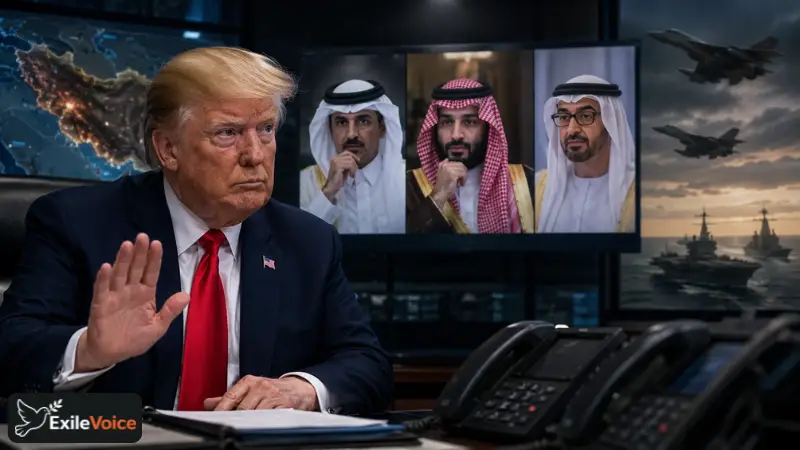
In a major foreign policy development shaking the global diplomatic landscape, US President Donald Trump announced the sudden suspension of a highly classified military strike against the Islamic Republic of Iran. The strike, which was scheduled to be authorized on Tuesday, was abruptly called off following direct personal interventions from key Gulf Arab heads of state. This development, breaking via an announcement by Trump on his platform, Truth Social, marks a temporary de-escalation in an increasingly volatile geopolitical stand-off.
According to top-level administrative and media disclosures, the diplomatic breakthrough came after intense, back-to-back communications between Washington and the leadership of Qatar, Saudi Arabia, and the United Arab Emirates. President Trump explicitly noted that the Emir of Qatar, Sheikh Tamim bin Hamad Al Thani, Saudi Crown Prince Mohammed bin Salman Al Saud, and UAE President Mohamed bin Zayed Al Nahyan had personally requested the United States to hold off on its planned military options. This represents a distinct shift in the mediation mechanics of Middle Eastern conflicts, where regional powers are actively asserting direct influence over Washington's military calculus.
Concurrently, reports confirm that Iran has relayed an amended 14-point diplomatic proposal to the Trump administration. The negotiation pipeline, heavily facilitated through ongoing Pakistani diplomatic mediation, indicates that behind the aggressive rhetoric broadcast by Tehran’s state media lies a high degree of structural flexibility. Analysts suggest that the recurring cycle of American military threats followed by Iranian policy revisions demonstrates a highly calculated pressure game. Every time Washington signals a definitive shift toward direct kinetic action, Tehran utilizes its diplomatic channels, chiefly Pakistani backchannels, to soften its bargaining position and present fresh terms.
The central pillar of these high-stakes negotiations remains Iran’s nuclear program. In his public statements regarding the deferred military options, Trump reiterated his uncompromising demand that any permanent diplomatic settlement must explicitly guarantee no nuclear weapons for Iran. While Tehran has historically maintained a formal religious stance against the acquisition of weapons of mass destruction, Washington continues to push for ironclad, verifiable, and legally binding commitments. The escalation and subsequent diplomatic freeze serve as a reminder of how close the region remains to a broader regional war, even as international mediators work around the clock to secure a sustainable framework.
Despite the current pause, the operational posture of the United States military remains at peak readiness. Trump confirmed that he has issued directives to the Secretary of Defense and the Chairman of the Joint Chiefs of Staff, General Dan Caine, instructing all combat units to remain fully prepared to execute the planned military options at a moment’s notice. The strategic intent is clear: while diplomacy has been granted an operational window at the behest of Gulf allies, the military threat remains an active element of American foreign policy.
International news agencies quoting senior diplomatic sources note that both Washington and Tehran have a history of moving the goalposts during these intensive backchannels. The current window for a finalized diplomatic resolution is incredibly narrow. With regional security hanging in a delicate balance, the next few weeks will determine whether the joint mediation efforts of Gulf partners and Pakistani diplomats can successfully convert this temporary freeze into a comprehensive regional peace accord.

