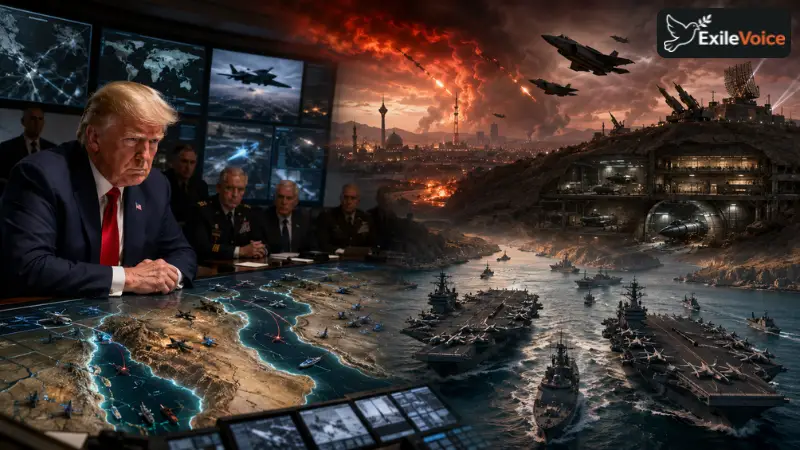
The White House is actively evaluating a series of high-risk military frameworks designed to target Iranian operational capabilities, creating immense urgency across global defense networks and international commodity markets. The strategic shifts in Washington have become increasingly evident following President Donald Trump’s abrupt alteration of his domestic travel itinerary, canceling scheduled personal engagements to return directly to Washington for pressing national security briefings. While a final, definitive command for execution has not been authorized, US military deployments in the region have been placed on high alert, indicating that comprehensive contingency plans are fully operational.
Defense analysts and intelligence reports indicate that the most immediate, logistically accessible option under review by the administration is a highly concentrated, intensive wave of precision airstrikes. This operational framework is designed to target critical defense infrastructure in Tehran and other major urban centers, allowing the administration to swiftly claim a decisive tactical victory. However, this strategy carries severe systemic risks. Defense documentation highlights that a brief, intense bombing campaign followed by a unilateral declaration of victory would likely trigger immediate asymmetric retaliation from Iranian forces.
Furthermore, intelligence assessments confirm that over the last several weeks, Iran has aggressively rebuilt and reinforced its national air defense networks. Reports indicate that Tehran has received substantial military replenishments, specialized hardware, and advanced air defense components from Russian networks. Iranian military engineers have utilized the recent lull in overt hostilities to harden potential targets, burying critical assets deep underground and significantly upgrading their defensive positioning, which diminishes the long-term efficacy of a localized aerial bombardment.
The second primary operational path under evaluation within the Pentagon is a comprehensive blockading strategy, frequently referred to as Blockade Plus. This framework extends beyond standard maritime interdictions to actively suppress Iran's mining operations, anti-ship capabilities, and strategic maneuvers within the critical Strait of Hormuz, where global energy supplies remain highly vulnerable. Executing this strategy effectively would demand a prolonged, multi-domain campaign involving naval, aerial, and potentially localized amphibious ground operations to neutralize Iran's vast fleet of fast-attack boats, mobile missile launchers, and specialized island installations.
The logistical footprint for such an escalation is already established on the ground. The United States maintains a formidable naval and aerial presence in the theater, anchored by two active aircraft carrier strike groups and approximately 17 guided-missile destroyers. In terms of ground forces, the administration possesses immediate, elite deployment options, including thousands of paratroopers from the 82nd Airborne Division and heavily equipped Marine Expeditionary Units, specifically trained for rapid-response amphibious operations. The presence of these elite units underscores the reality that Washington possesses the concrete capacity to shift from deterrence to active combat operations at a moment's notice.
The internal political pressure on the administration to execute a decisive action is immense. High-ranking legislative figures, particularly within the Senate Republican leadership, have formally communicated with the White House, urging the president to bring a definitive end to the protracted Iranian security challenge. Concurrently, international energy markets have demonstrated acute sensitivity to these developments, with global oil prices fluctuating sharply in response to changing expectations regarding the security of Middle Eastern supply lines. As the military timeline contracts, the balance between active deterrence and an open, multi-domain conflict remains exceptionally fragile.