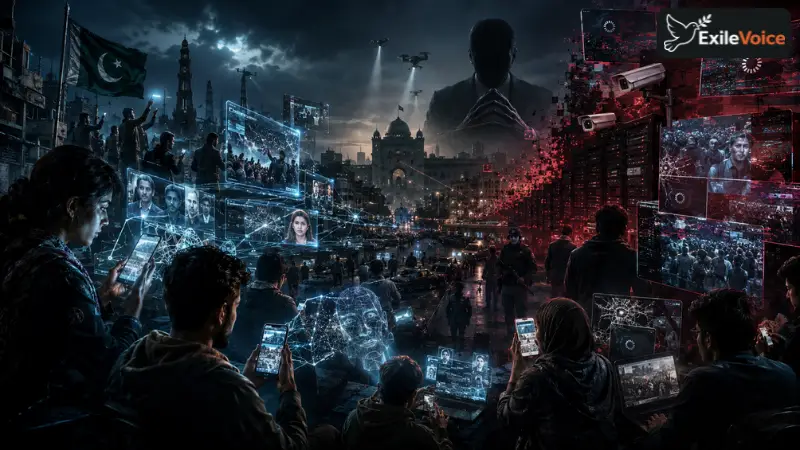
In the wake of May 9, the frontline of Pakistani politics shifted from the streets of Lahore and Islamabad to the servers of Silicon Valley and the handheld devices of millions of citizens. This article examines the emergence of a "Digital Frontline," where the state and the opposition engage in a sophisticated tug-of-war over information, truth, and narrative. The video analysis reveals a growing trend: the use of Artificial Intelligence (AI) by "Gen Z" activists to keep the political discourse alive despite heavy censorship on mainstream media.
The use of AI in this context is groundbreaking. Activists have deployed AI to create high-quality video content, recreate historic speeches, and even generate satirical imagery that mocks the powerful. This is not just about creativity; it is a survival strategy. When mainstream TV channels are barred from mentioning a specific leader’s name, AI and social media platforms become the only avenues for outreach. This has led to an interesting paradox where the "Alternative Media" has, in many ways, become more influential than the state-sanctioned "Mainstream Media."
However, the state’s response has been equally technological. The phenomenon of "Shadow Banning" and the throttling of internet speeds during political events have become standard operating procedures. The analysis indicates that platforms like YouTube and X (formerly Twitter) have seen significant disruptions, with users reporting "buffering" and decreased engagement. These are not merely technical glitches; they are deliberate attempts to "choke" the flow of information. For professionals in the communication and tech sectors, Pakistan has become a case study in how a state can attempt to implement a "digital iron curtain" within a democratic framework.
Furthermore, the "Information War" has led to a proliferation of competing truths. On one side, the state presents a narrative of a "planned conspiracy" to burn down national symbols. On the other, the opposition provides "witness accounts" and video evidence suggesting the presence of "planted agents" designed to incite violence and justify a crackdown. The video highlights specific instances where civilians identified individuals in plain clothes emerging from military vehicles during the protests. The existence of these conflicting digital archives means that the "truth" of May 9 will likely remain contested for decades, with each side possessing its own set of "digital proofs."
The long-term implication of this digital warfare is the erosion of public trust in all institutions. When every video can be dismissed as "deepfake" or "propaganda," and every official statement is met with digital counter-evidence, the concept of a shared national reality disappears. As Pakistan navigates this era of "Alternative Truths," the challenge for the professional journalist and the concerned citizen remains the same: how to verify information in an environment designed to obscure it.