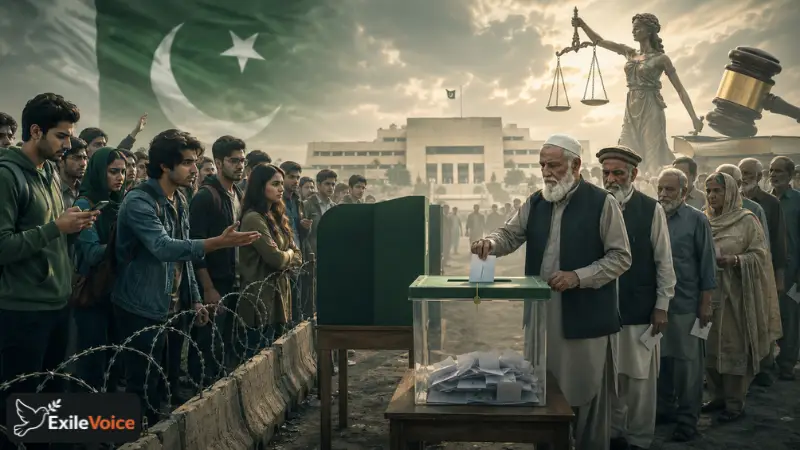
Demographic shifts represent one of the most powerful forces driving modern constitutional engineering and state stability. In developing democracies, the youth cohort often possesses the structural leverage to fundamentally disrupt or entrench dominant political systems. Consequently, recent policy proposals within Pakistan’s legislative circles aiming to alter the foundational demographic parameters of the electorate, specifically by raising the minimum voting age from 18 to 25 years, merit a detailed, objective sociological and structural analysis. This proposal sits at the intersection of electoral governance, constitutional rights, and strategic demographic management.
To fully understand the scale of this proposed policy, one must analyze the raw statistical architecture of Pakistan’s electorate. Data from the Election Commission of Pakistan indicates that out of a total voting population exceeding 130 million individuals, the youth cohort between the ages of 18 and 45 accounts for approximately 67 percent of the entire voting bloc. Within this massive demographic pillar, the segment spanning 18 to 25 years constitutes a highly critical sub-group of nearly 25 million citizens. Therefore, any legislative initiative that redefines electoral eligibility across this seven-year spectrum is not a minor administrative tweak; it is a profound structural intervention that instantly alters the geometric balance of national political representation.
From the viewpoint of legal philosophy and constitutional consistency, the argument to raise the voting age introduces serious contradictions within the state’s legal frameworks. The state currently recognizes individuals at 18 years of age as fully autonomous legal entities. At this threshold, a citizen is legally entitled to enter binding marriages, inherit and manage substantial property portfolios, register commercial entities, and secure a National Identity Card.
Furthermore, the state’s defense and administrative frameworks regularly recruit citizens within this exact demographic window. Young men and women enter military academies, receive advanced tactical commissions, and assume immense operational responsibilities over state security assets. Similarly, individuals under 25 are legally eligible to clear competitive civil service examinations and enter administrative offices. To argue that a citizen possesses the requisite intellectual and civil maturity to command defense units, enter marital contracts, or manage corporate structures, while simultaneously claiming they lack the cognitive capacity to cast a ballot, creates an unsustainable legal paradox.
Sociologists and political analysts point out that this policy conversation is deeply tied to shifting political trends among the country's youth. Historical data from recent electoral cycles, including the pivotal elections of February 2024, show an increasingly active, tech-savvy, and politically engaged young demographic. International political observers note that despite state-level media restrictions or narrative control measures, the youth population consistently leverages decentralized digital networks to build political communities and resist traditional state-directed narratives. This digital mobilization has decoupled youth political identity from conventional, patronage-based regional networks.
Consequently, independent experts view the proposal to restrict the franchise to citizens aged 25 and older as a form of defensive demographic engineering. By reducing the size of an unpredictable, digitally native voting bloc, the proposed policy attempts to return electoral outcomes to more predictable, older, and tradition-bound demographics. However, history demonstrates that institutional attempts to manage political stability by disenfranchising large population sectors frequently backfire. Excluding a vibrant, highly connected generational group from the formal political process does not eliminate their political expression; instead, it redirects that energy away from mainstream electoral structures and toward alternative, less controllable forms of civil discontent and extra-legal activism.