The domestic political landscape remains defined by complex backchannel communications between the security establishment and major political opposition factions. Analytical reports indicate a deliberate reduction in overt hostility between the military leadership and senior representatives of Pakistan Tehreek-e-Insaf (PTI). These negotiations seek to establish a stable operating framework ahead of upcoming fiscal budget announcements, an institutional period historically marked by public dissatisfaction and macroeconomic volatility.
The parameters of these backchannel discussions involve mutual structural concessions. The opposition leadership has reportedly agreed to limit direct rhetorical criticism of top-tier military commanders and restrict public protests to designated municipal zones. In exchange, the state apparatus has offered incremental administrative relief. This includes facilitating family and legal visitations for detained political figures, reducing immediate judicial pressures in pending trials, and managing the release of low-level political workers.
However, independent analysts observe that these purported agreements often function as state-sponsored narratives designed to project a false sense of political stability. Material evidence of comprehensive political relief remains minimal. Legal counsel for high-profile detainees continues to face procedural barriers, including demands to proceed with arguments without standard documentation, suggesting that the underlying state strategy remains focused on long-term judicial containment rather than genuine reconciliation.
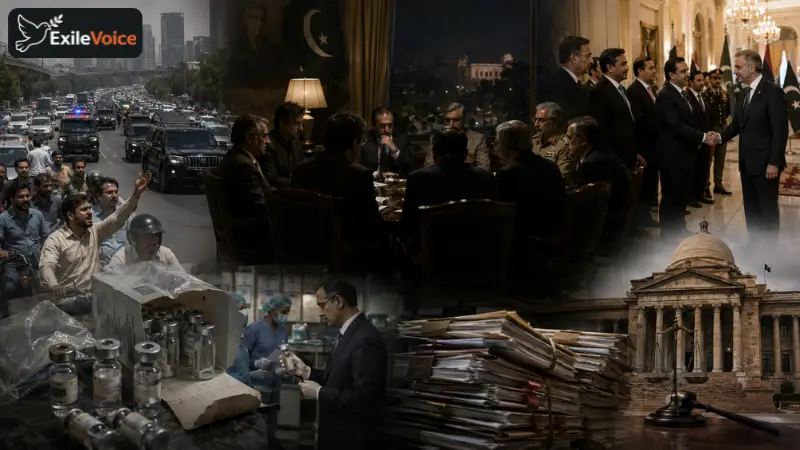
Concurrently, public discontent regarding state-enforced privileges is manifesting openly across major urban centers. In Karachi, extensive traffic closures implemented for official state convoys led to spontaneous public resistance, with citizens utilizing vehicular horns to protest prolonged road closures. The resulting confrontations between public commuters and specialized security units highlight an eroding threshold for official protocols that disrupt economic activity during periods of high fuel inflation.
In terms of regional diplomacy, senior administrative figures have engaged in high-level state functions to signal strategic shifts. The arrival of international dignitaries, such as Prince Rahim Aly Khan of the Ismaili community, saw coordinated receptions involving the presidency, the prime minister, and the chief of army staff. While these events project diplomatic continuity, external observers note a sharp contrast between state-funded official banquets and a domestic economic environment marked by escalating inflation and reported spikes in poverty-driven household crises.
On the international front, diplomatic activity has shifted toward neighboring states, with federal ministries conducting official visits to Iran. These engagements coincide with international speculation regarding potential transitional agreements between Washington and Tehran, designed to establish short-term frameworks for regional trade and security coordination.
Concurrently, geopolitical alignment strategies are visible within academic and provincial circuits. An international relations conference at the University of Chakwal drew public scrutiny following the display of foreign flags, illustrating the sensitive nature of regional diplomatic recognition. Observers link these developments to broader state-directed efforts to explore complex diplomatic channels, including subtle engagements via third-party states like Azerbaijan. Azerbaijan represents a critical geopolitical node due to its energy corridors and established diplomatic ties with external actors, offering a discreet venue for non-traditional regional diplomacy.
Meanwhile, federal regulatory bodies are confronting severe market failures within domestic critical sectors. The Drug Regulatory Authority of Pakistan (DRAP) recently issued recall directives for counterfeit oncology medications distributed across major public healthcare facilities. The investigation revealed that high-cost injections targeting advanced carcinomas featured sophisticated, forged packaging of international pharmaceutical firms, while containing inert or unverified chemical compounds. The discovery of these counterfeit batches, prompted by clinical reporting from oncology specialists noting a total lack of patient therapeutic response, has highlighted deep vulnerabilities within national pharmaceutical supply chains and public procurement oversight.