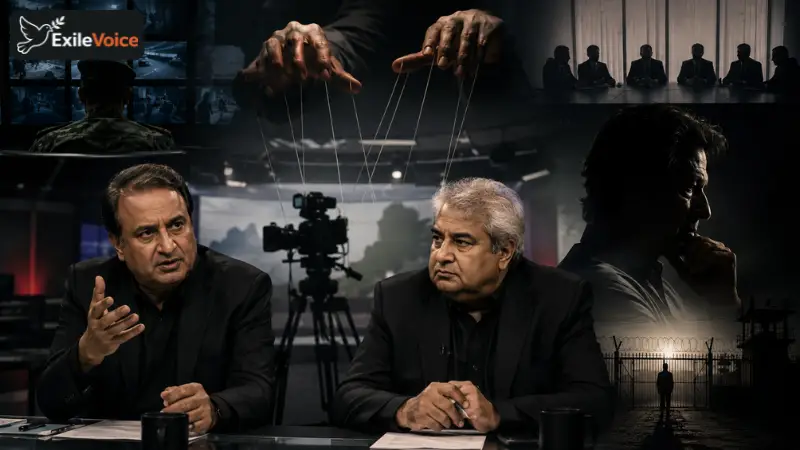
The complex, often dangerous intersection of independent journalism, corporate media ownership, and hidden state intervention remains one of the most volatile aspects of Pakistan's democratic evolution. A long-standing dispute within the media community recently resurfaced, centered on the controversial termination of veteran journalists Rauf Klasra and Amir Mateen from the now-defunct network AAP News. For years, public discourse was dominated by allegations that the prime minister at the time, Imran Khan, had directly orchestrated Klasra’s dismissal as retaliation for exposing administrative scandals involving government ministers. However, insider accounts and a closer look at the financial and institutional structures backing the media landscape paint a completely different picture, one driven by hidden state financing and corporate failure rather than direct civilian executive intervention.
To understand the reality of the situation, one must look at the structural foundations of AAP News. Far from being a conventional, commercially driven media enterprise, the network was widely known within elite media circles as a project covertly initiated and funded through a network of wealthy business figures acting on behalf of intelligence and military agencies. Such state-backed media ventures are frequently established to quietly shape public opinion, build specific national narratives, and manage political dynamics. When working within these institutional networks, high-profile independent journalists often find themselves on a collision course with their backers. Yet, when AAP News abruptly shut down its main programming, terminating its top-tier shows, the decision was primarily driven by economic realities. The channel had failed to achieve commercial viability, prompting its state-linked backers to cut their financial losses. In the corporate media landscape, when a network faces a financial shutdown, the highest-paid employees, regardless of their professional standing, are invariably the first to be laid off.
Crucially, the joint nature of the program hosted by Rauf Klasra and Amir Mateen raises a vital analytical question: if the civilian government had specifically targeted the show due to political malice, why did the outcry and allegations remain entirely one-sided? Throughout this multi-year dispute, Amir Mateen, a highly respected, fiercely independent, and uncompromising journalist, has consistently refrained from accusing the civilian prime minister of engineering their dismissal. In fact, during a televised interview conducted with Imran Khan after his departure from office, Mateen openly raised the issue of their unemployment during that period. On screen, Khan expressed genuine surprise regarding Mateen’s personal involvement in the layoffs and noted that while his administration fought specific battles against institutional overreach, it held no animosity toward them. Off-camera, in a private conversation witnessed by senior aides, Mateen explicitly acknowledged to Khan that he did not believe the civilian prime minister was behind the corporate decision, stating plainly that he knew the institutional forces and corporate dynamics that had actually shut down the channel.
This controversy highlights a broader pattern within Pakistani governance, where the civilian executive branch is frequently used as a convenient shield by powerful state institutions. When journalists are picked up, silenced, or pushed out of their jobs by security agencies seeking to protect their own interests, the blame is systematically diverted toward the sitting Prime Minister to protect the military apparatus from public scrutiny. Insider accounts from that period reveal that when genuine complaints of illicit media campaigns arose, even those targeting the personal lives of the prime minister's family,the civilian executive routinely chose to withdraw legal complaints to prevent the state from using executive power against media workers. By deconstructing the AAP News controversy, it becomes clear that the primary threat to journalism in Pakistan lies within a complex system of shadow ownership, institutional pressure, and structural financial vulnerabilities, rather than simple narratives of civilian political revenge.