

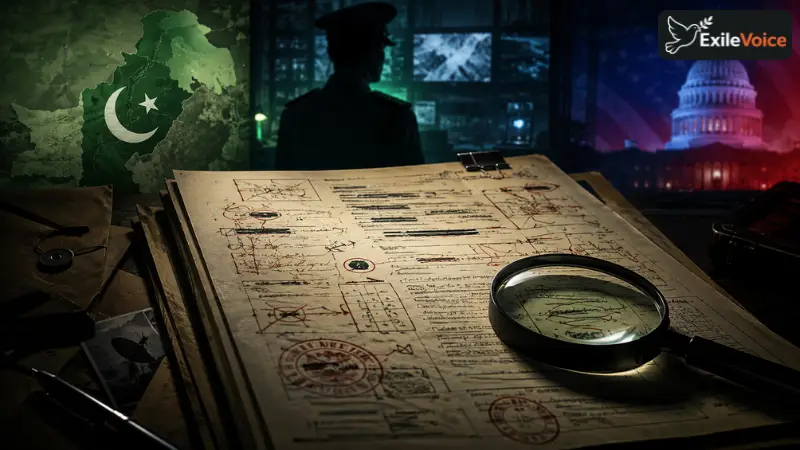
The geopolitical landscape of South Asia has been profoundly shaken by the public release of an authenticated, unredacted, and annotated copy of the highly controversial Pakistani diplomatic cipher. Published via the independent journalism platform Drop Site News by investigative reporters Ryan Grim, Murtaza Hussain, and Waqas Ahmed, this documentation marks a pivotal moment in Pakistan's contemporary political history. For years, the narrative surrounding the cipher, a classified diplomatic cable detailing a meeting between U.S. State Department official Donald Lu and the then-Pakistani Ambassador to the United States, Asad Majeed Khan, was dismissed by mainstream state structures as a political fabrication or an exaggeration designed to foster populist support. However, the forensic reality of the newly leaked physical copy completely refutes these dismissals, shifting the structural burden of accountability onto the country's military and intelligence command centers.
A rigorous forensic evaluation of the document's markings provides definitive proof regarding its origin and routing trajectory. Institutional attempts within the Pakistani state machinery, alongside compliant media actors, have sought to frame the leak as an unauthorized disclosure tracing back to the Prime Minister's Secretariat under Imran Khan. This narrative is categorically disproven by the routing checkboxes and official metadata stamped onto the face of the document itself. Within the strict procedural protocols of Pakistani state bureaucracy, sensitive diplomatic communications are distributed in strictly numbered, individual physical copies to specific institutional repositories, including the Prime Minister's Office, the Foreign Secretary, the Directorate General of Inter-Services Intelligence (DG ISI), and the Chief of Army Staff (COAS) Secretariat. Each department marks its respective copy upon reception to log accountability.
The specific copy obtained and verified by investigative journalists bears unique physical markings, structural cross-outs, and precise organizational checkmarks that map directly to the military apparatus. Specifically, the clear indicators correspond directly to either the COAS Secretariat or the DG ISI executive office, leaving the civilian administrative offices completely outside the chain of custody for this specific document copy. This forensic confirmation exposes a severe internal failure or deliberate act of disclosure from within the highest ranks of the garrison in Rawalpindi, fundamentally undermining the state's narrative that civilian oversight was solely responsible for compromising state secrets.
The structural substance of the communication validates the core thesis that the political removal of Prime Minister Imran Khan was explicitly encouraged and monitored by external actors. The critical text focuses heavily on the transactional ultimatum issued by Donald Lu during the official meeting on March 7, 2022. Lu explicitly communicated that if the impending vote of no confidence against Khan succeeded, "all would be forgiven in Washington". Conversely, if the civilian leader survived the constitutional maneuver, Pakistan would face immediate, systemic diplomatic and economic isolation from western financial structures. This explicit transactional demand demonstrates how deeply integrated international geopolitical maneuvers are with domestic civilian administration shifts, revealing that the structural sovereignty of peripheral states is routinely challenged by dominant global actors seeking strategic compliance.

