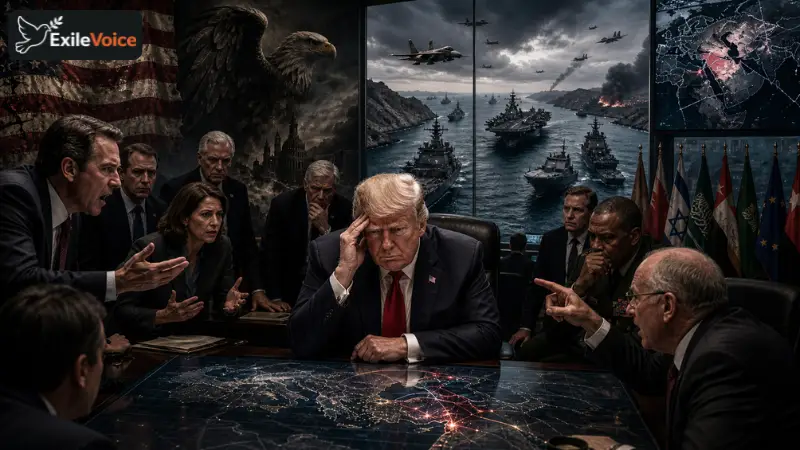
As the U.S. military initiates maneuvers in the Persian Gulf, a fierce debate is erupting within Washington’s strategic community regarding the efficacy and long-term consequences of President Donald Trump’s foreign policy. Prominent voices in the American media and academia are increasingly describing the current administration’s actions as signs of a "superpower in decline," rather than a show of strength.
The criticism centers on a perceived lack of an exit strategy. Critics argue that while the Trump administration is adept at initiating confrontations, it often fails to manage the subsequent fallout. This sentiment was echoed by German Chancellor Friedrich Merz, whose recent comments regarding America’s lack of a strategic "off-ramp" in the Iran conflict sparked a diplomatic row. Trump’s retaliatory decision to withdraw 5,000 troops from Germany is seen by many as a self-defeating move, as these forces are vital for U.S. global logistics and medical support rather than just German defense.
The internal American sentiment is reflected in high-profile opinion pieces, such as those in the New York Times, which have labeled the current military efforts as "Operation Coastal Blunder." There is a growing consensus among analysts that Iran, despite suffering immense economic damage, has managed to maintain a level of strategic resilience that embarrasses the U.S. administration. This perception of "strategic defeat" has reportedly fueled a sense of desperation in the White House, leading to erratic policy shifts, one day praising Iranian "reasonableness" and the next threatening total destruction.
Adding to the complexity is the recent surge in U.S. arms sales. The State Department recently bypassed Congressional approval to authorize an $86 billion armament sale to regional partners. Reports suggest that 6,500 metric tons of ammunition have already arrived in the Persian Gulf. For critics, this suggests that the administration is preparing for a "kinetic" solution to the Iran problem because its diplomatic efforts have failed to produce a clear victory.
The narrative of an empire in decline is further bolstered by the fraying of traditional alliances. The United Arab Emirates’ recent decision to exit OPEC+ and align more closely with U.S.-Israeli interests is viewed as a fragmentation of the Gulf Cooperation Council (GCC). While this provides the U.S. with a dedicated regional proxy, it weakens the collective stability of the Middle East. As Trump prepares for his meeting with President Xi Jinping, the pressure to prove that America still dictates global terms is at an all-time high, creating a volatile environment where a single miscalculation could lead to disaster.