

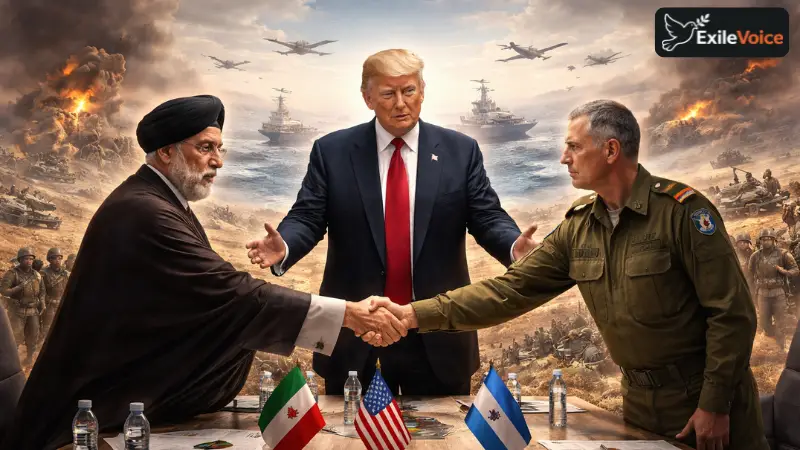
The landscape of the Middle East underwent a seismic shift on April 17, 2026, as a cessation of hostilities was declared in Southern Lebanon. This development, characterized by many as a "class-taking" moment by U.S. President Donald Trump toward Israeli Prime Minister Benjamin Netanyahu, marks a definitive turning point in regional dynamics. For the first time in recent history, an American President explicitly ordered an end to Israeli military operations, citing that "enough is enough."
The ceasefire did not emerge in a vacuum. It was the result of a complex interplay of failed military objectives and intense diplomatic maneuvering. Despite a month of intensive operations, the Israeli Defense Forces (IDF) found themselves unable to reach the Litani River, a key strategic objective. Instead, they remained bogged down within a ten-kilometer safety zone, facing persistent guerrilla warfare and rocket fire from Hezbollah. This military stalemate provided the necessary opening for diplomatic intervention.
Central to this peace process was a specific demand from Iran. Tehran made it clear through diplomatic channels, largely facilitated by Pakistan, that the reopening of the Strait of Hormuz was contingent upon a ceasefire in Lebanon. President Trump, recognizing the economic toll of high oil prices and domestic inflation on his administration's standing, chose to prioritize regional stability over continued military escalation.
The immediate aftermath of the ceasefire saw Iran fulfilling its end of the bargain by declaring the Strait of Hormuz open for commercial maritime traffic. This move had an instantaneous effect on global markets, with oil prices plummeting and stock indices like the S&P 500 surging. However, the path to a lasting peace remains fraught with "Beltway politics" and deep-seated conspiracies. While the "war-war" phase may have transitioned to a "jaw-jaw" phase, the internal pressures within Washington, driven by powerful lobbies and regional interests like those of the UAE, continue to threaten the fragile stability.
The ceasefire is currently viewed not as a definitive victory for any single side, but as a strategic retreat into diplomacy. Israel faces internal criticism for what is perceived as a strategic failure, while Iran has successfully leveraged its control over maritime routes to secure a halt to operations against its proxy, Hezbollah.

