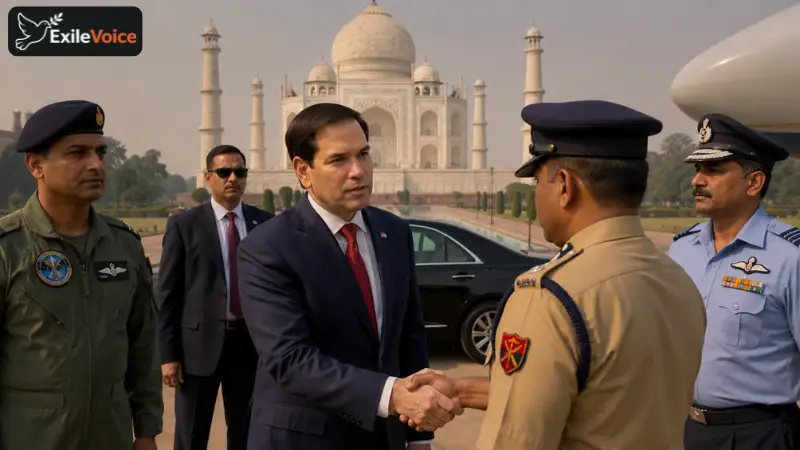
The geopolitical landscape of South Asia experienced a sharp diplomatic shift during US Secretary of State Marco Rubio official visit to India. While addressing a joint press conference in close proximity to the historic Taj Mahal in Agra, Rubio explicitly endorsed India's long-standing security narrative regarding cross-border terrorism. His statements highlighted that India's concerns regarding cross-border subversion originating from Pakistani soil remain factually accurate. This overt acknowledgement by a top US diplomat signals a recalibration of Washington's strategic alignment in the region, prioritizing its defense relationship with New Delhi over historically transactional security arrangements with Islamabad.
The timing of this diplomatic declaration is highly significant, occurring as a major international mediation process unfolds behind the scenes. Pakistan has actively facilitated delicate back-channel diplomacy between the United States and Iran, a process that experts believe could yield a stabilizing regional framework within the next 48 hours. By delivering an public indictment of Pakistan's internal security framework at such a critical juncture, the United States appears to be drawing a strict line between operational cooperation on Persian Gulf stability and long-term strategic validation in South Asia.
Domestically, this development has created an uncomfortable counter-narrative for Islamabad's military and civil leadership. For several months, official briefings from the Inter-Services Public Relations (ISPR) have pointed to regional external sponsorship, often using terminology such as Indian-sponsored subversion, to explain the rise in militant activity across Khyber Pakhtunkhwa and Balochistan. The recent tragic railway attack in Balochistan further underscored these internal security vulnerabilities. However, the American diplomatic focus remained exclusively on Pakistan's internal operational landscape, highlighting a persistent disconnect between Islamabad's domestic public relations strategy and Washington's formal intelligence assessments.
Furthermore, the diplomatic protocols surrounding Rubio's visit sparked intense public debate in regional media circles. Observers noted that the Secretary of State was received at the Agra airbase by local law enforcement and military commanders rather than high-ranking federal ministers. In mature democracies, private or semi-official cultural excursions by foreign dignitaries routinely operate under decentralized regional protocols rather than centralized state welcomes. The over-analysis of these hospitality procedures by domestic commentators underscores a deeper, structural preoccupation with visual validation and political optics, a pattern that frequently obscures the more substantive, policy-driven shifts occurring in international statecraft.