

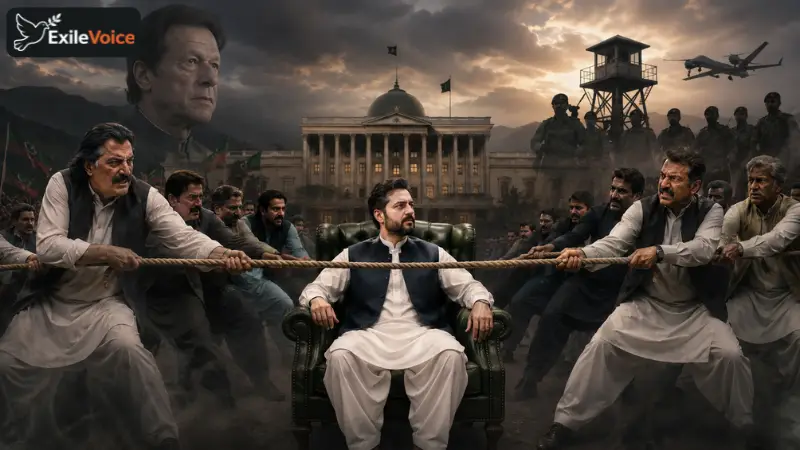
The political landscape of Khyber Pakhtunkhwa (KP) has once again entered a period of sharp volatility, driven by breaking news reports, institutional friction, and intense speculation regarding the stability of Chief Minister Suhail Khan Afridi’s administration. Recent reports circulating across major national media outlets suggest that a formidable forward bloc comprising nearly 50 Members of the Provincial Assembly (MPAs) has emerged within the ruling party. According to these accounts, this dissident faction has united around a single agenda: the removal of Chief Minister Afridi, citing severe dissatisfaction with his administrative performance and governance style.
In response to these viral reports, provincial insiders and government representatives have moved swiftly to quell the panic. The KP Information Minister, Shafi Jan, issued an unequivocal denial, stating that the reports of an internal rebellion lack any factual basis. Jan emphasized that Chief Minister Afridi was explicitly nominated by Imran Khan, the jailed founding chairman of Pakistan Tehreek-e-Insaf (PTI), and subsequently secured a legitimate vote of confidence from the provincial legislature. According to the official government stance, the parliamentary party remains entirely unified behind Afridi's leadership, rendering any talk of an organized coup inside the assembly obsolete.
However, the political narrative becomes more complex when connected with recent legal challenges. Politician Sher Afzal Marwat filed a formal petition in the newly established constitutional court, challenging the legal validity of Chief Minister Afridi’s election. Marwat's petition argues that because Imran Khan was convicted and disqualified at the time of the appointment, his decisions from jail, including the abrupt removal of former Chief Minister Ali Amin Gandapur and the subsequent nomination of Afridi, hold no legal weight. The petition formally requests the court to declare Afridi’s election null and void and restore Ali Amin Gandapur to the office of Chief Minister.
Independent political analysts view these fast-moving developments through two distinct lenses. The first theory suggests that a genuine backdoor conspiracy is underway, orchestrated by powerful institutional actors alongside political figures like Gandapur to regain control of the strategic border province. Gandapur, known for his deep financial influence and strong personal relationships with sitting provincial legislators, possesses the political capital necessary to mobilize such a faction if given the green light by the establishment.
The second, more calculated theory posits that these reports of a 50-member forward bloc are entirely artificial, designed as a classic strategic distraction. By trapping the provincial leadership and the party’s grassroots workers in an exhausting cycle of internal survival, institutional operators can effectively drain the party's energy. This prevents the provincial government from focusing on broader national objectives, such as organizing large-scale protests or demanding the release of Imran Khan. Given that the military establishment maintains firm control over the province's security apparatus, drone operations, and anti-terrorism initiatives, there appears to be little administrative necessity to change the civilian face of the province. Consequently, the rumor of an imminent vote of no confidence functions primarily as an effective tool for political containment.

