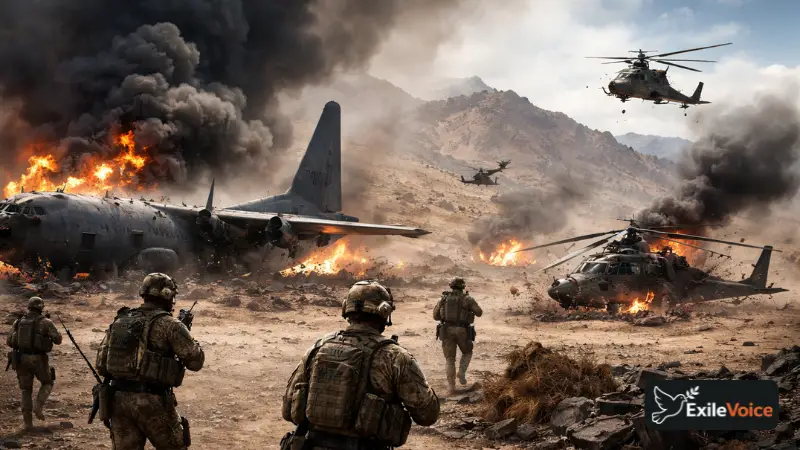
On April 5, 2026, a high-stakes military operation unfolded deep within Iranian territory, marking one of the most sensational rescue missions in recent American history. While President Donald Trump initially hailed the recovery of a downed American service member as a flawless victory and a testament to U.S. air superiority, emerging details suggest a much more chaotic and costly reality. Independent reports from major outlets like the Wall Street Journal and the New York Times have begun to peel back the layers of the official narrative, revealing significant hardware losses that contrast sharply with the administration’s "zero casualty" claim.
The operation, aimed at recovering a high-ranking officer, identified as a colonel, who had been evading Iranian forces in a mountainous region, involved dozens of aircraft and hundreds of special operations personnel, including the elite Navy SEAL Team Six. Despite the successful extraction of the pilot, the mission saw the destruction of at least two C-130 Hercules transport aircraft. Valued at approximately $100 million each, these specialized planes were reportedly "scuttled" or intentionally destroyed by U.S. forces after they became stuck or suffered mechanical failures in the desert terrain. This measure was taken to prevent sensitive technology and equipment from falling into the hands of the Islamic Revolutionary Guard Corps (IRGC).
The Iranian perspective offers an even more volatile account. Iranian officials, including Parliament Speaker Baqer Qalibaf, have characterized the event as a "Pyrrhic victory." Qalibaf’s social media posts featured images of charred aircraft wreckage, mocking the American claim of success. Tehran claims to have shot down two Black Hawk helicopters and an Israeli-operated Reaper drone during the skirmish. Furthermore, Iranian sources report that the heavy American bombing campaign intended to provide cover for the rescue resulted in at least five to ten Iranian fatalities and numerous injuries.
This operation draws haunting parallels to "Operation Eagle Claw" in 1980, the failed attempt to rescue American hostages in Iran that ended in a desert collision and political disaster for the Carter administration. While the 2026 mission succeeded in its primary goal of recovering the service member, the loss of $200 million in transport aircraft and the alleged loss of helicopters suggests that the "complete dominance" touted by the White House was met with significant resistance. As the dust settles, the political fallout for President Trump remains uncertain. While the rescue serves as a morale booster, the substantial military cost and the conflicting reports of the engagement may provide ammunition for critics who question the strategic transparency of the mission.