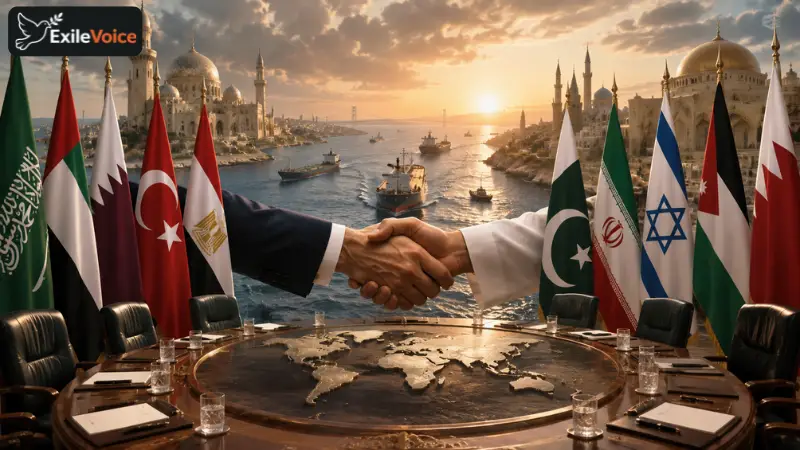
A major shift is taking place in global diplomacy as negotiations for a landmark memorandum of understanding between the United States and the Islamic Republic of Pakistan near formal completion. This emerging framework, aimed at restoring regional stability and establishing a baseline for sustainable peace, has engaged structural heavyweights across the Middle East and South Asia. High-level discussions orchestrated out of the Oval Office have brought together the top-tier leadership of Saudi Arabia, the United Arab Emirates, Qatar, Turkey, Egypt, Jordan, and Bahrain. Crucially, the diplomatic calculus also incorporates active communication channels with Israel, indicating an exhaustive, multi-axial approach to de-escalating one of the world's most enduring geopolitical flashpoints.
One of the most consequential operational elements of the proposed agreement is the structured reopening of the Strait of Hormuz. As a vital chokepoint handling a significant percentage of global maritime petroleum traffic, its stabilization holds immediate economic ramifications for international markets. The diplomatic architecture required to reach this stage underlines the return of pragmatic, deal-oriented foreign policy, where multi-lateral concessions are prioritized to mitigate broader systemic disruptions.
For Pakistan, this unfolding agreement presents both an extraordinary strategic opportunity and a complex governance challenge. The federation has played a significant behind-the-scenes role in facilitating communication channels, positioning itself as a critical bridge. Historically, regional mediation of this scale allows a state to leverage its diplomatic capital for tangible domestic benefits. However, analysts note a distinct imbalance in how Pakistan is currently conducting its high-stakes external negotiations.
A balanced approach to international diplomacy requires a state to baseline its external cooperation against critical domestic needs. In Pakistan's context, the immediate geopolitical theater demands resolution on water security disputes, such as the ongoing restrictions on the Chenab River flow, and the realization of cross-border energy projects. The proximity to Iran offers a natural economic avenue for acquiring cost-effective liquefied natural gas and petroleum products to alleviate the domestic energy crisis.
Maximizing these opportunities requires an integrated foreign policy apparatus capable of engaging international media, cultivating global diplomatic networks, and directly binding regional stability pacts to sovereign economic relief. Without aligning high-level multilateral engagements with domestic economic security, external breakthroughs risk yielding minimal long-term benefits for the state's internal stability.