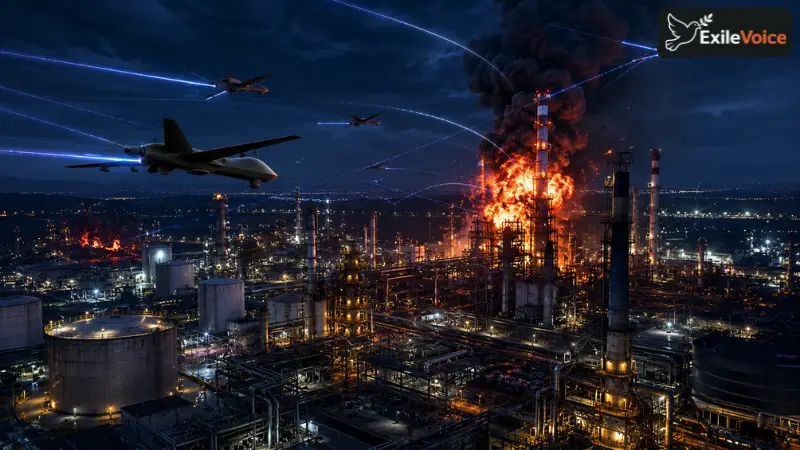
The battlefield dynamics of the ongoing conflict between Ukraine and the Russian Federation have undergone a significant technological and tactical evolution, morphing into what military strategists now define as the world’s first total drone war. Over the past 48 to 72 hours, the Ukrainian Armed Forces have executed a series of highly synchronized, long-range unmanned aerial vehicle (UAV) assaults targeting the absolute core of Russia’s economic engine: its domestic oil refineries and energy infrastructure. Moving far beyond localized tactical reconnaissance and front-line artillery support, these newly deployed Ukrainian strike drones have successfully penetrated deep within sovereign Russian territory, causing catastrophic explosions across major refining facilities. This strategic shift aims to directly starve the Russian military machine of processed fuel while systematically disrupting the Kremlin’s primary source of hard currency revenue.
This intensive campaign represents a deliberate rejection of static defensive warfare by Kyiv. Ukrainian President Volodymyr Zelenskyy’s recent operational declarations confirm that this asymmetrical campaign will not only continue but will expand in technological scope. The videos emerging from the targeted energy sectors reveal a sophisticated deployment of next-generation autonomous drones that utilize advanced electronic warfare resistance measures. These platforms are engineered to bypass complex Russian air defense umbrellas, including the S-400 missile grids and automated electronic jamming fields. By targeting highly specific, structurally vulnerable components of oil refineries, such as distillation columns and catalytic cracking units, Ukrainian drone operators are maximizing long-term industrial damage using relatively inexpensive, mass-produced kinetic assets.
This evolution in unmanned combat has fundamentally altered the global defense paradigm. Modern conflict is no longer entirely dictated by traditional, multi-billion-dollar military assets like heavy armored divisions or conventional fourth-generation fighter squadrons. Instead, it is increasingly dominated by decentralized swarms of low-cost, AI-integrated autonomous aerial systems. The massive industrial destruction witnessed across Russian energy grids highlights a stark reality: heavily funded conventional militaries remain structurally unequipped to defend sprawling national infrastructure against low-signature, mass-scale drone swarms.
As these technologies undergo rapid, real-time testing on the battlefields of Eastern Europe, they provide a blueprint for non-state actors and smaller nation-states. This shifts the global balance of power by demonstrating how advanced industrial states can be systematically destabilized through calculated, low-cost technological asymmetric warfare.