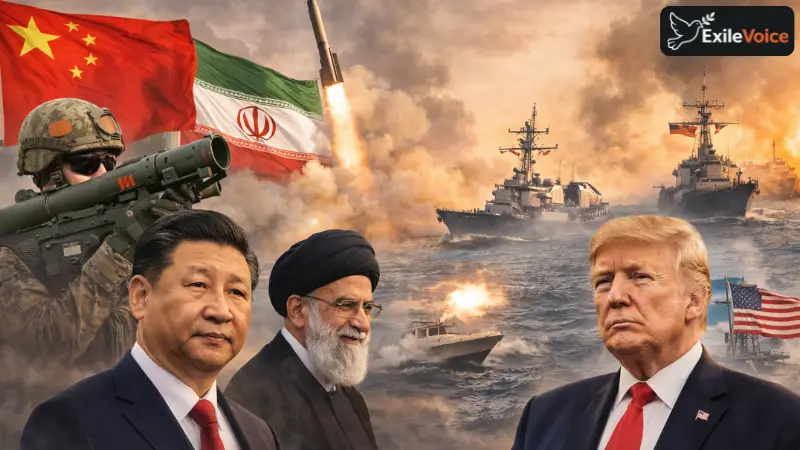
As the diplomatic dust settles in Islamabad, a new and more complex narrative is emerging: the active entry of China into the Middle East conflict. Just as the talks between the U.S. and Iran hit a stalemate, reports began to surface regarding secret Chinese military support for Tehran. U.S. intelligence agencies are reportedly assessing claims that Beijing is providing sophisticated weaponry, including Man-Portable Air-Defense Systems (MANPADS) and missile technology, to Iranian forces. This development suggests that the regional conflict is transitioning from a bilateral struggle into a broader geopolitical "Season 2" involving global superpowers.
The timing of these intelligence leaks is notable. As Vice President JD Vance issued his final warning to Iran, President Donald Trump remarked that any Chinese military involvement would be "very bad news" for Beijing. This rhetoric indicates that the U.S. is prepared to pivot its pressure from Tehran to its backers in the East. For months, the U.S. has maintained that it has "obliterated" Iran’s primary military capacity; however, the infusion of Chinese technology could rapidly rebuild those capabilities, neutralizing the "strategic victory" claimed by the Trump administration.
The entry of China changes the stakes for regional players like Pakistan and Saudi Arabia. Previously, the conflict was seen as a regional fire that could be contained through local mediation. Now, with the potential for Chinese-made missiles to defend Iranian airspace or target maritime traffic in the Strait of Hormuz, the conflict takes on a "Cold War" dimension. This shift complicates Pakistan's mediation efforts, as it must now navigate the sensitivities of its "all-weather friend" Beijing while hosting high-level American delegations.
Furthermore, the naval theater is seeing increased activity. While the talks were ongoing, U.S. destroyers entered the Strait of Hormuz under the guise of "mine-sweeping" operations. Iran issued a "final warning" via radio, asserting its territorial waters. This maritime friction, combined with the news of Chinese military supplies, suggests that the "silent" war of intelligence and logistics is heating up. The world must now consider if the Islamabad deadlock was merely a precursor to a much larger, more dangerous confrontation involving the world’s two largest economies.