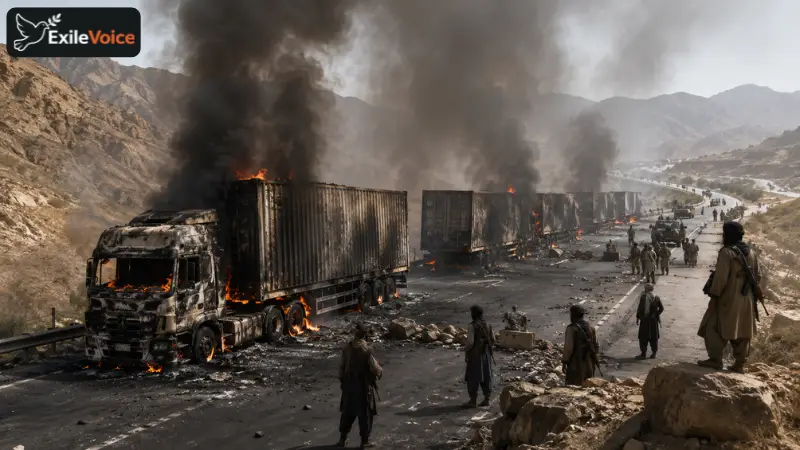
The deteriorating security situation in Balochistan has reached a critical flashpoint following a brazen, large-scale insurgent operation along the strategic N-40 National Highway in Nushki. In broad daylight, heavily armed militants successfully established illegal checkpoints, blocked the arterial commercial highway, and systematically intercepted a convoy of approximately 30 commercial transit containers. The attackers proceeded to set the entire fleet of cargo trailers ablaze, completely destroying vital goods and infrastructure. Initial economic assessments indicate that the financial toll is staggering, with individual containers carrying high-value commercial cargo valued at up to 150 million PKR each.
The scale of this economic sabotage is compounded by a profound breakdown in the local security and deterrence architecture. Ground intelligence reveals that the specific geographic zone where the militants operated with complete impunity is heavily fortified, with over 3,000 personnel from the paramilitary Frontier Corps (FC) deployed in the immediate and surrounding sectors. The fact that an insurgent force could execute a time-consuming operation, stopping 30 massive transport vehicles, offloading or neutralizing drivers, and burning them to the ground, without triggering an immediate, overwhelming tactical response from nearby military outposts raises serious questions.
This incident is not an isolated event but rather indicative of a broader tactical shift by militant groups operating in Balochistan. Insurgents are increasingly moving away from low-impact hit-and-run attacks against isolated security posts, choosing instead to target the economic arteries of the state. By disabling major highways and inflicting catastrophic financial losses on commercial transport networks, the militancy aims to choke regional trade and project an image of total state paralysis. The psychological impact on local traders, international logistics partners, and ordinary citizens is profound, as the primary transit routes connecting Pakistan to regional trade hubs are no longer safe for basic transit.
The growing disconnect between state propaganda and ground realities continues to widen. While national leadership frequently projects an image of stability and invites foreign investment into regional infrastructure projects, the inability to protect domestic commerce along primary highways paints a grim picture. The failure of thousands of deployed paramilitary personnel to prevent daylight sabotage on an economic lifeline highlights deep structural inefficiencies in intelligence coordination, mobility, and defensive readiness. Without a radical overhaul of the security strategy in Balochistan, the province risks falling into economic isolation, rendering multi-billion-dollar trade corridors practically unusable.