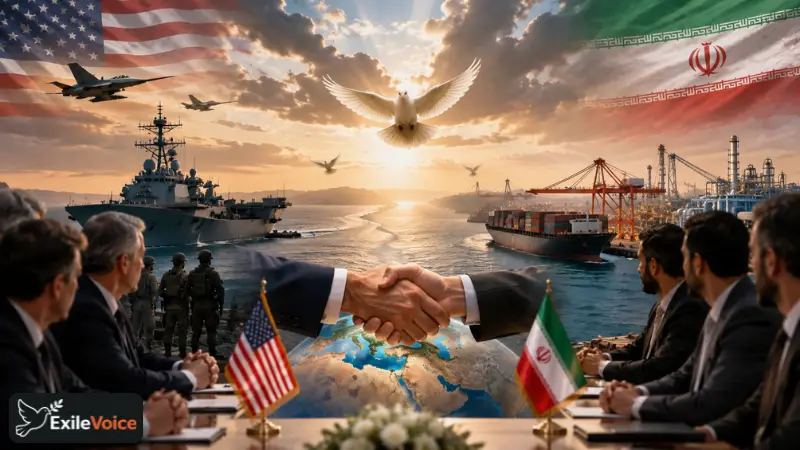
The landscape of Middle Eastern geopolitics shifted dramatically following an announcement by US President Donald Trump that a highly anticipated peace deal with the Islamic Republic of Iran has been largely negotiated. The declaration, which was signaled via Trump's Truth Social platform and subsequently acknowledged by official military communication channels in Tehran, marks an extraordinary conclusion to an intense escalation that pushed the global community to the brink of a major regional war.
The breakthrough comes at a critical juncture. For weeks, the international community watched with growing alarm as military posturing threatened to spill over into a direct, catastrophic kinetic engagement. Early signs from Washington had pointed toward maximum pressure, with early morning media releases showing a US flag symbolically draped over the map of Iran. However, the diplomatic backchannels rapidly gained traction, transforming a volatile military standoff into a historic diplomatic pivot.
According to high-level diplomatic insights, the negotiated settlement is structured as an all-inclusive package deal designed to address the foundational grievances of both Washington and Tehran. Central to the agreement is the immediate easing of maritime tensions, specifically ensuring that the strategic Strait of Hormuz remains entirely open and unhindered for international shipping. In exchange, the United States has reportedly agreed to a phased pullbacks of its forward-deployed forces from critical friction zones and the lifting of severe naval blockades that have paralyzed multiple Iranian ports and commercial vessels.
Furthermore, the deal addresses long-standing financial disputes that have fueled enmity for decades. Billions of dollars in Iranian assets, frozen in international banking systems due to various tranches of US sanctions, are slated to be unfrozen. This massive capital injection provides Tehran with vital economic relief, rendering the prospect of a diplomatic settlement highly appealing to domestic stakeholders.
The reaction from global news outlets has been uniform in confirming the advanced state of the talks. Outlets ranging from Al Jazeera to the Financial Times and Bloomberg have verified that the framework of the agreement has been solidified following intensive consultations between the United States and a powerful coalition of Middle Eastern and South Asian leaders. However, the path to implementation remains highly sensitive. Emerging details published by the New York Times indicate that a potential spoiler remains regarding the disposition of Iran's enriched uranium, with US officials pushing for the transfer of "yellowcake" uranium as a foundational component of the permanent non-proliferation framework.
Despite these technical hitches, sources within Tehran report that the atmosphere remains highly constructive. Senior Iranian officials have described the current phase of the peace process as highly attainable, noting that while external actors may seek to sabotage the progress, the mutual economic and military exhaustion of both primary combatants has created a durable window for a lasting ceasefire.