The security environment in Balochistan has deteriorated dramatically following a series of highly coordinated attacks targeting military convoys and security outposts across the province. The deadliest incident, occurring in the Nok Kundi region, resulted in at least 16 confirmed casualties among security forces, marking one of the most severe tactical setbacks for the military in recent months. Coupled with simultaneous ambushes in the Kech district, these events underscore expanding insurgent capabilities and systemic operational vulnerabilities along strategic security corridors in southwestern Pakistan.
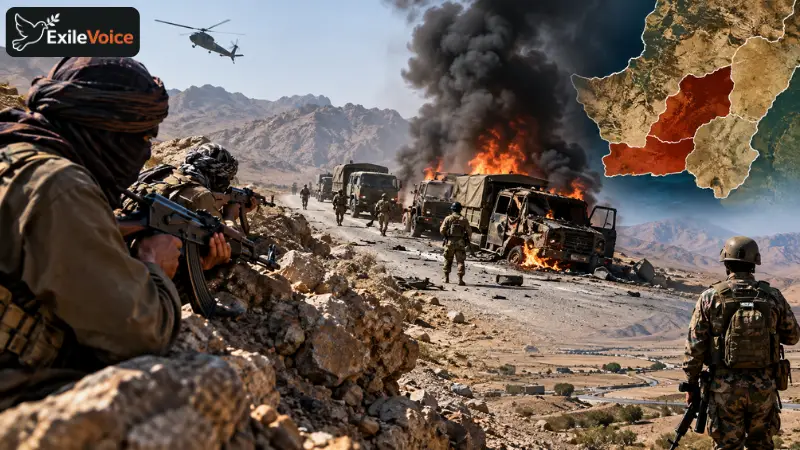
The attack in Nok Kundi involved heavy weaponry and sophisticated ambush tactics designed to isolate security patrols in remote desert terrain. Local intelligence reports indicate that insurgent elements ambushed a multi-vehicle military force, disabling transport units before engaging in prolonged firefights. Visual evidence and ground reports revealed critical gaps in immediate casualty evacuation and emergency response protocol, with damaged vehicles and fallen personnel left unattended along transit routes for extended periods. This operational lag points to severe logistical constraints and delayed air-support capabilities in remote border districts.
Simultaneously, in Kech district, an armed force estimated at over 100 insurgent fighters launched a synchronized assault targeting a military convoy and an adjacent security checkpoint. The assault utilized anti-tank weaponry, automated fire, and improvised explosive devices, inflicting significant damage on state infrastructure and security personnel. The scale and coordination required to mobilize over 100 fighters in a heavily monitored security zone indicate significant operational intelligence failures and potential gaps in local surveillance networks.
These violent surges illustrate a clear tactical evolution among active insurgent groups in Balochistan. Moving away from isolated hit-and-run tactics, separatist factions are increasingly executing battalion-level ambushes against fortified installations and heavily armed convoys. This strategic shift poses direct threats to key economic assets, transport infrastructure, and foreign investment initiatives linked to international trade corridors across the province. The inability of state apparatuses to secure primary supply lines compromises broader economic stabilization efforts.
Furthermore, state response mechanisms have drawn criticism for an apparent lack of operational transparency. Information regarding troop casualties is frequently restricted, with formal acknowledgments limited primarily to officer rank personnel. This policy of selective reporting creates an information vacuum, hindering public accountability and masking the true human toll borne by low-ranking service members on the front lines. To stem the rising tide of violence, defense planners must fundamentally re-evaluate counter-insurgency doctrines, prioritizing real-time intelligence integration, rapid response logistics, and comprehensive socio-political engagement in Balochistan.