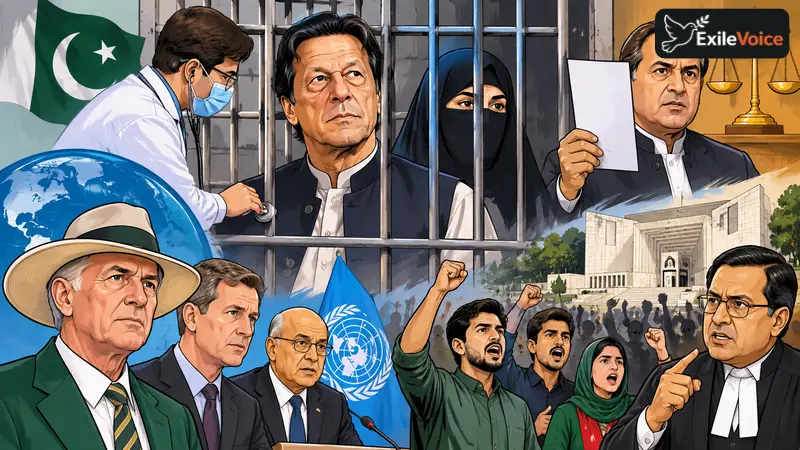
Developments surrounding incarcerated former prime minister Imran Khan, ongoing legal disputes among political figures, and fresh allegations of harsh treatment against political workers and activists converged on November 21, 2026, keeping questions of due process, prison oversight, and political accountability at the center of public discussion. Official updates indicated that a medical team from the Pakistan Institute of Medical Sciences conducted a checkup on Imran Khan and Bushra Bibi at Adiala Jail, addressing concerns about health and vision while prompting renewed calls from critics and supporters for independent access by personal physicians, family members, and legal counsel.
International attention to Imran Khan's prolonged imprisonment and health conditions has continued to build, adding diplomatic and reputational pressure on authorities. Commentary highlighted renewed public appeals by former Australian cricket figures, including Greg Chappell, urging medical care and release, alongside earlier expressions of concern from international cricketing personalities and United Nations human rights bodies regarding arbitrary detention standards. For observers following Pakistan's international standing, sustained commentary from global sporting icons and multilateral human rights mechanisms turns a domestic legal and political standoff into a broader test of institutional credibility abroad.
Within domestic politics, tensions have also spilled into heightened security crackdowns and disputes over detained activists. Accounts regarding party figures and young workers, including reports surrounding Taimur Saleem Jhagra and youth member Shayan Bashir after release from custody, have fueled arguments that aggressive detentions and pressure tactics carry a heavy human and political cost. Supporters of the Pakistan Tehreek-e-Insaf argue that such actions intimidate dissent and discourage civic participation, whereas state authorities maintain that law enforcement actions are taken under existing legal frameworks to preserve public order.
Parallel to these high-stakes political clashes, a sharp personal and legal feud erupted in the legal and political arena when Captain (retired) Muhammad Safdar served a Rs10 billion defamation notice on Advocate Mian Dawood on November 21, 2026, demanding an unconditional public apology over allegedly insulting remarks made on social media and in video statements. The dispute grew out of earlier controversies involving bar council degree verifications and fierce exchanges among rival legal and political actors, illustrating how personal grievances, online rhetoric, and high-value defamation claims have become prominent features of public contention.
Together, these episodes show how deeply legal proceedings, custodial controversies, and public messaging are intertwined in contemporary Pakistani politics. When medical transparency in prison, the treatment of detainees, international human rights scrutiny, and high-profile defamation notices unfold simultaneously, public confidence in impartial institutions faces severe strain. Meaningful transparency on medical care, adherence to due process in detentions, and resolution of disputes through established judicial channels remain essential to easing polarization and restoring faith in the rule of law.