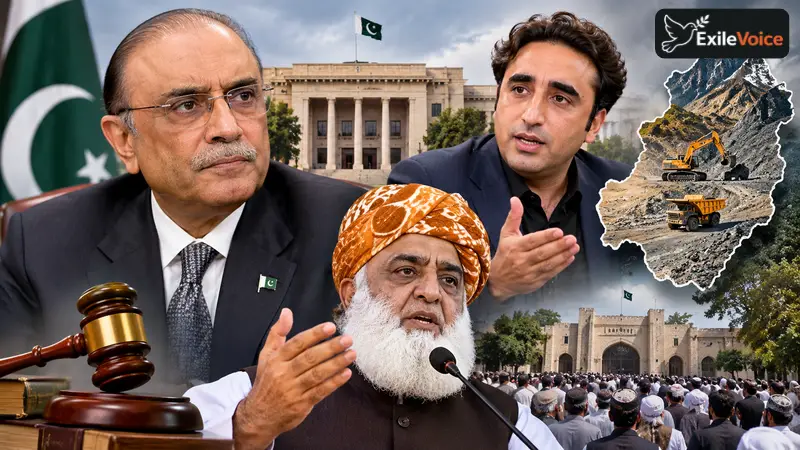
President Asif Ali Zardari approved five ordinances affecting legislation and governance in Khyber Pakhtunkhwa on November 21, 2026, triggering intense political scrutiny over federal executive reach, provincial autonomy, and control over strategic resources in the province. The rapid issuance of these ordinances immediately drew sharp commentary across Pakistan's political landscape because it coincided with public rhetoric from Pakistan Peoples Party Chairman Bilawal Bhutto Zardari questioning emergency powers and governor's rule, highlighting an apparent divergence in tone and tactical approach within the ruling alliance.
Among the measures approved are the Khyber Pakhtunkhwa Special Initiatives Ordinances for 2026 covering designated districts as well as the broader province, the Khyber Pakhtunkhwa Societies Registration (Amendment) Ordinance 2026, an ordinance altering privileges, immunities, and perquisites associated with the provincial assembly, and legislation governing the salaries, allowances, and privileges of the speaker and deputy speaker. Critics of the ordinances argue that sweeping executive decrees concentrate authority, weaken legislative checks, and create avenues to tighten administrative control over land, registration frameworks, and state assets in Khyber Pakhtunkhwa. Proponents and official narratives frame security and administrative coordination in volatile border and tribal areas as urgent imperatives requiring decisive executive tools.
The timing of the five ordinances also intersected with a high-profile address delivered on November 21, 2026, by Jamiat Ulema-e-Islam leader Maulana Fazlur Rehman at the Peshawar High Court Bar Association, followed by reports of an invitation to address the Karachi bar. In his speech, Fazlur Rehman argued that security conditions in parts of the province had improved enough that his own security detail had been withdrawn, while contending that emergency measures and curfews in tribal belts and districts such as Tank, Bannu, Lakki Marwat, and Dera Ismail Khan were disproportionately tied to mineral extraction, smuggling routes, and movement of valuable commodities rather than sustained counterterrorism alone. His remarks sharpened an ongoing national debate over who benefits from natural resources in Khyber Pakhtunkhwa and the former Federally Administered Tribal Areas.
At the same time, political observers noted contrasting dynamics surrounding opposition figures and bar associations. While some opposition leaders have faced restrictions on public gatherings or bar appearances in the past, Fazlur Rehman's engagements with legal bodies drew close attention from analysts evaluating whether shifting alignments among political actors and state institutions were reshaping opposition strategy. Separately, a brief immigration hold on Fazlur Rehman's brother, Zia ur Rehman, at a Karachi airport upon returning from abroad before he was permitted to proceed home underscored the uneven way security and administrative measures are experienced across different political families and movements.
Taken together, the November 21 ordinances and the Peshawar bar address illuminate a central tension in Pakistan's federal system: how security imperatives, executive ordinance-making, and provincial resource rights are balanced against constitutional norms and representative governance. In Khyber Pakhtunkhwa, where economic grievances, cross-border instability, and disputes over mineral wealth converge, legislative changes issued by ordinance carry immediate consequences for local institutions, civil society organizations, and public trust. Whether these measures restore order and administrative efficiency or deepen perceptions of central overreach will remain a defining question for policymakers, legal practitioners, and citizens in the months ahead.