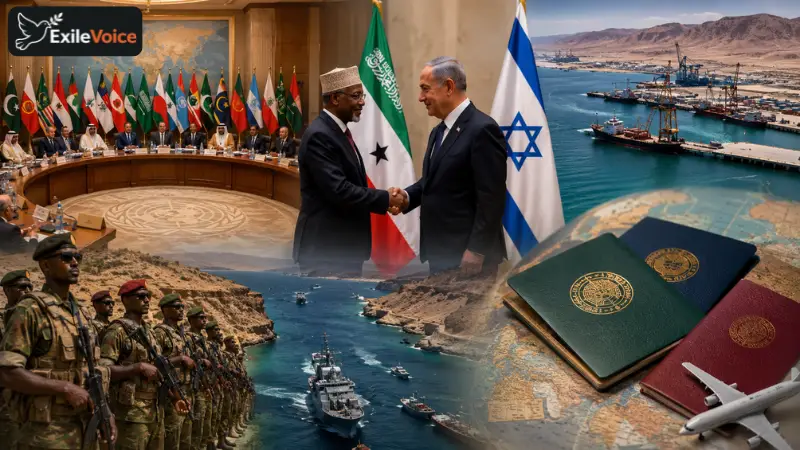
The announcement that Somaliland intends to establish a formal diplomatic mission in Jerusalem has introduced a volatile new variable into the geopolitics of the Horn of Africa and the Red Sea basin. A coalition of fourteen nations, including Pakistan and Saudi Arabia, issued a joint diplomatic memorandum strongly condemning the initiative. The international community overwhelmingly adheres to the position that Somaliland remains an autonomous region within the federal borders of the Federal Republic of Somalia, rather than a sovereign entity capable of independent diplomatic recognition.
Somaliland's historical trajectory explains its unconventional approach to foreign policy. Originally a British protectorate positioned strategically along the Gulf of Aden, the territory briefly gained independence in late June 1960 before voluntarily entering into a political union with Italian Somaliland to form the Somali Republic. Following decades of highly centralized governance and a brutal military campaign executed by the military dictatorship of General Siad Barre in the late 1980s, Somaliland unilaterally declared the restoration of its independence in 1991. Despite establishing an independent currency, a centralized standing army, and regular democratic elections, the region has spent over three decades seeking formal de jure recognition from the United Nations.
The decision to establish a presence in Jerusalem represents a deliberate geopolitical calculation designed to leverage Israeli political influence in exchange for strategic access. For Israel, a formalized partnership with Somaliland offers a significant foothold near the Bab-el-Mandeb strait, a critical maritime chokepoint vulnerable to regional proxy forces. This strategy has received quiet support from the United Arab Emirates, which has already invested heavily in developing Somaliland's deep-water port facilities at Berbera, establishing a robust commercial and logistics presence outside the immediate oversight of the federal government in Mogadishu.
Concurrently, regional passport architectures are being adjusted to reflect shifting ideological alignments across South Asia. The government of Bangladesh recently directed its Ministry of Home Affairs to restore explicit geographic exclusions on its national passports, explicitly declaring the document invalid for travel to Israel. This administrative reversal rescinds a 2021 policy decision that had omitted the phrase, bringing Dhaka back into alignment with the long-standing passport protocols maintained by Pakistan and Malaysia. These administrative adjustments show that even as non-state and semi-autonomous entities like Somaliland seek out new, non-traditional security partnerships, established states in Asia are reaffirming traditional diplomatic boundaries.