

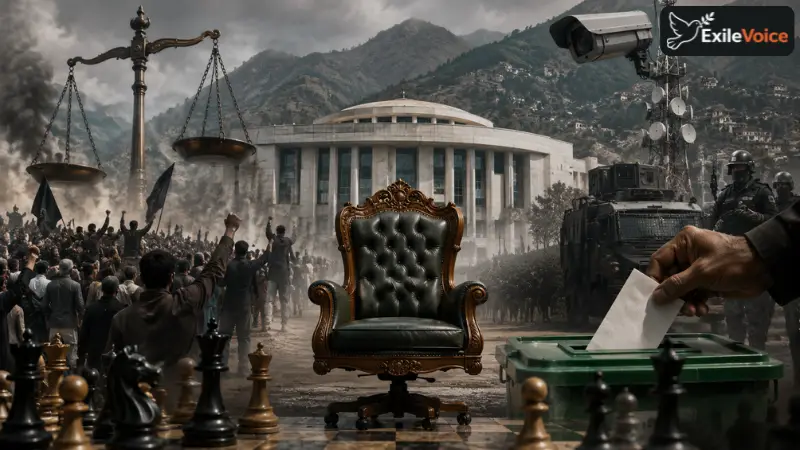
The political landscape of Azad Kashmir has experienced profound disruption, highlighted by the collapse of its democratic processes during the legislative assembly elections. The region operates with 53 total seats, comprising 45 directly elected general seats and eight reserved seats. Historically, the 2021 elections resulted in a clean sweep for Pakistan Tehreek-e-Insaf (PTI), which secured 32 seats and established a majority government. However, subsequent political maneuvers significantly altered this trajectory through systematic institutional and judicial interventions.
A pivotal turning point occurred in April 2023 with a judicial intervention that disqualified the incumbent Prime Minister, Sardar Tanveer Ilyas, following a contempt case. This legal ruling paved the way for the formation of a forward block. The assembly speaker at the time, Chaudhry Anwar-ul-Haq, broke away from PTI to form a 12-member forward block, subsequently securing the premiership through coalitions with the Pakistan Peoples Party (PPP) and Pakistan Muslim League-Nawaz (PML-N).
This arrangement proved temporary for the orchestrators themselves. In the winter of November, Anwar-ul-Haq faced a successful no-confidence motion backed by 36 members from the PPP and PML-N, leading to the immediate installation of Faisal Mumtaz Rathore of the PPP as Prime Minister. Such extensive political engineering over a span of nearly three years ultimately fractured the political dominance of PTI in the region. Frustrated by these continuous interventions, PTI opted to boycott the subsequent electoral phase.
The electoral environment during the recent phase across constituencies in Mirpur, Kotli, and Bhimber districts was heavily overshadowed by civic unrest. The Joint Awami Action Committee (JAAC) spearheaded numerous protests over socioeconomic grievances, facing severe state crackdowns that resulted in numerous casualties. International bodies, including Amnesty International and the United Nations High Commissioner for Human Rights, raised serious concerns regarding the legitimacy of an electoral process conducted amid systemic suppression, internet restrictions, and the detention of political figures. The ongoing disenfranchisement and erosion of representative governance reflect deep structural challenges facing the region's democratic framework.

