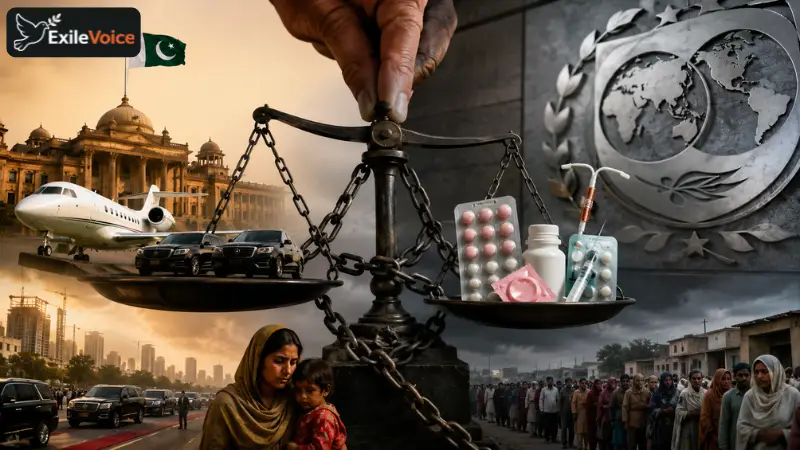
The structural economic challenges in Pakistan have reached a pivotal juncture, highlighting deep friction between the enforcement of strict international monetary lending terms and the core preservation of national sovereignty. Recent disclosures from Islamabad have intensified public and academic discourse regarding the operational terms of the International Monetary Fund (Ref: IMF) financial assistance programs. A major flashpoint emerged following an official media briefing by the Finance Minister, where it was confirmed that administrative tax exemptions on essential contraceptive materials and foundational public healthcare pharmaceuticals are subject to formal regulatory validation from international lenders.
This structural alignment underscores the profound level of fiscal oversight currently exercised by global financial institutions over domestic budgetary architecture. Analysts observe that when basic social safety nets, demographic strategies, and reproductive health policies require explicit external consensus, the traditional boundary of national self-determination becomes significantly compromised. Critics contend that while macroeconomic stabilization demands rigorous financial management, the extension of fiscal conditionalities into minor health-sector line items represents an unsustainable model of economic governance.
The broader systemic issue is rooted in a sharp escalation of national debt over successive political cycles. Statistical evaluations indicate a staggering growth in public borrowing, with recent cumulative debts outstripping historic multi-decade benchmarks. This compounding fiscal deficit has systematically diminished the state's domestic financial cushion, making continuous reliance on external bailouts structurally unavoidable.
Concurrently, a stark contrast is visible between the severe austerity measures forced upon essential public sectors and the ongoing capital allocations directed toward state administrative luxury. Public frustration has heightened following reports of substantial treasury outlays for high-profile executive transport assets, including specialized aircraft acquisitions for provincial and federal leaders. This divergence in resource prioritization, where fundamental social services undergo rigorous tax scrutiny while elite administrative overhead remains insulated,raises significant institutional questions regarding equitable fiscal stewardship during a national economic crisis.
Ultimately, the present reliance on international lending programs emphasizes the critical need for structural domestic tax reforms, the optimization of state-owned enterprises, and a transparent expenditure framework. Without a coherent strategy aimed at achieving genuine self-reliance, the domestic policy space will continue to narrow, leaving essential social and developmental priorities structurally subordinate to foreign debt servicing obligations.