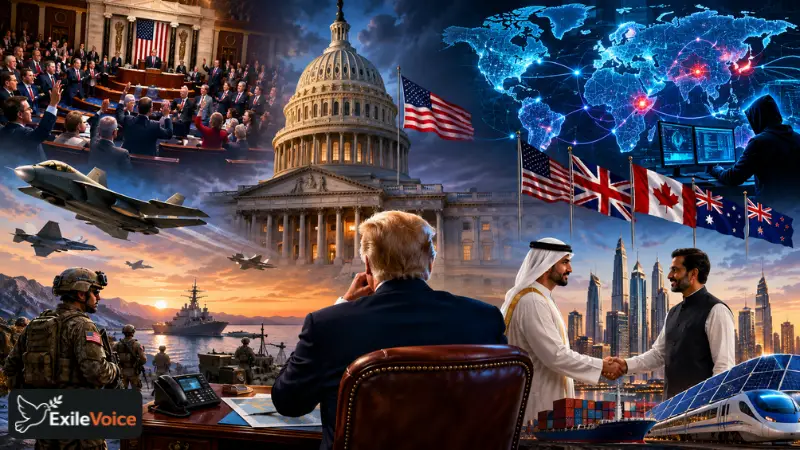
A major legislative shift occurred in Washington as the United States House of Representatives passed a landmark bill aimed at curbing executive war powers, specifically restricting the president's authority to initiate military action against Iran without explicit congressional approval. The bill passed with a razor-thin margin of 215 to 208 votes, highlighting the deep polarization within the American legislative framework. Notably, the vote crossed party lines, with four Republican lawmakers defecting from the party stance to support the Democrat-led initiative.
Historically, the executive branch has utilized legal loopholes, including a 60-day unilateral military window, to execute short-term interventions abroad without a formal declaration of war from Congress. While the White House has argued that recent operations in the Middle East fell within legal parameters and concluded before triggering oversight mechanisms, lawmakers argued that ongoing low-level skirmishes constitute an unauthorized, protracted conflict. This legislative victory forces a strict constitutional check on the presidency, requiring a formal bill and floor debate before any future escalation with Tehran can be legally financed and executed.
In tandem with this legislative friction, intelligence assessments published by the Wall Street Journal suggest a tactical recalibration within the executive branch. Internal communications indicate that the presidency does not intend to pursue large-scale pre-emptive strikes against Iranian infrastructure or the Islamic Revolutionary Guard Corps (IRGC). The current defensive posture dictates that military retaliation will only be triggered in the event of direct, lethal attacks on American service personnel deployed in the region. This stance marks a significant departure from the aggressive, regime-change rhetoric championed by hardline regional lobbies and foreign allies, signaling a desire to avoid another costly, open-ended conflict in the Middle East.
Simultaneously, the global theater is witnessing a tightening of security alliances among Western nations. The "Five Eyes" intelligence network, comprising the United States, the United Kingdom, Canada, Australia, and New Zealand, issued a coordinated, joint security warning targeting state-sponsored cyber operations originating from China. The communique alleges that Beijing is conducting widespread, sophisticated online espionage aimed at harvesting citizen data and compromising institutional networks through commercial digital products.
This shifting global dynamic is also vibrating through South Asian diplomatic channels. Analysts point to a growing diplomatic realignment in the Gulf, noting that the United Arab Emirates (UAE) has significantly deepened its economic and strategic ties with India while distancing itself from traditional partners like Pakistan. The UAE's recent decisions to align closely with New Delhi on counter-terrorism declarations and bilateral trade, while maintaining a reserved stance on security developments within Pakistan, illustrates a broader global trend: international partnerships are increasingly dictated by economic synergy and technological integration rather than historical or ideological alignments.