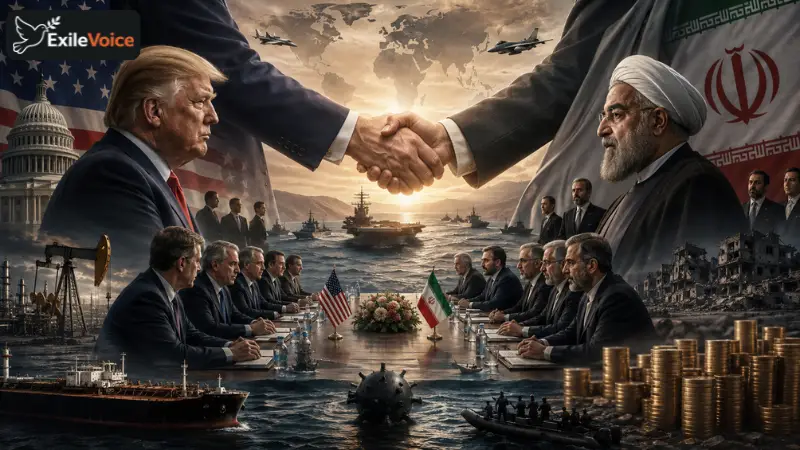
A major diplomatic breakthrough is emerging from Washington as the United States and Iran near a historic 60 day memorandum of understanding. This potential ceasefire, breaking across major global financial outlets and confirmed through preliminary White House briefings, aims to halt escalating hostilities and address critical security bottlenecks in the Middle East. The cornerstone of the proposed framework requires Iran to temporarily defer negotiations surrounding its nuclear weapons ambitions, focusing instead on immediate de-escalation milestones. Central to this phase is Iran’s commitment to hand over highly enriched uranium reserves and fully clear naval mines laid across the strategic shipping lanes of the Strait of Hormuz within a strict 30 day window.
In exchange, the United States will roll back the aggressive financial blockade under its ongoing economic campaign against Tehran. This economic freeze has throttled Iranian commerce for months, and its suspension is expected to trigger significant relief across global stock and energy markets. Furthermore, diplomatic sources indicate that the scope of this truce will quietly incorporate a cessation of hostilities in Lebanon, acknowledging the deeply intertwined relationship between Iranian regional proxies and broader Mediterranean stability.
However, the path to final execution remains fraught with domestic and international skepticism. While US Vice President JD Vance and other senior administration officials confirm that a deal is imminent, the final accord hinges entirely on an official sign-off from President Donald Trump. Domestic conservative factions, spearheading their critique through prominent financial publications, argue that dismantling the economic blockade prematurely strips Washington of its primary leverage before securing definitive nuclear concessions. Critics cite previous long-term negotiations as cautionary tales, warning that a brief 60 day window could easily be stretched by Tehran into years of diplomatic stalling while domestic military pressure dissipates.
Compounding the uncertainty are conflicting narratives and severe mistrust on the ground. Iran’s Islamic Revolutionary Guard Corps, speaking through state-affiliated media channels, has downplayed Western reports, branding them as speculative. They emphasize that the definitive negotiated text has not yet been formally delivered to international mediators, including Pakistan and Qatar.
Even as backchannel talks progress, overt military posturing continues to threaten the diplomatic track. Tehran recently claimed to have downed a sophisticated US aircraft near Bushehr using a newly deployed air defense system. This assertion was swiftly countered by US Central Command, which released operational footage from the USS Abraham Lincoln to verify that all sorties and regional flight operations remained entirely uninterrupted. The incident underscores the volatile mix of propaganda and hard military realities defining the current standoff.
Operationalizing the truce presents immense technical hurdles. Maritime experts note that clearing sophisticated underwater munitions from deep-water shipping channels is an intricate, high-risk endeavor that historically spans years, casting doubt on the realistic execution of a 30 day de-mining pledge. Additionally, systemic ambiguities persist regarding which negotiating draft, the Pakistani-mediated framework or the Qatari alternative, will serve as the foundational text.
The agreement also introduces a highly controversial surprise clause inserted by Iranian negotiators demanding a massive financial package designated as a reconstruction or investment fund to counter historical economic damage. While viewed by critics as thinly veiled war reparations, certain transactional factions within Washington may view the fund as a strategic post-war incentive to anchor peace through commercial infrastructure development. Whether President Trump approaches the impasse through a purely geopolitical lens or as a transactional business opportunity will ultimately determine the survival of this fragile diplomatic opening.