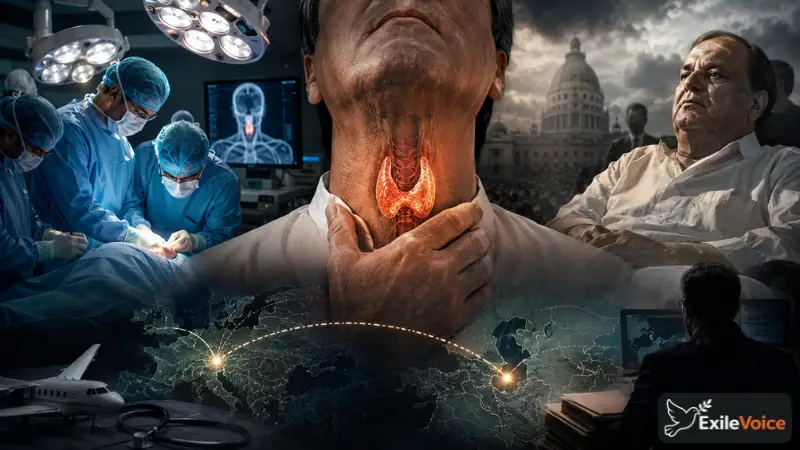
In contemporary political warfare, physical health, personal resilience, and medical transparency have mutated into central pillars of strategic communication. Political actors frequently utilize medical events to build empathy, assert an unyielding commitment to their home nation, or simulate populist commonality with the public. However, beneath the polished press releases and carefully timed hospital room updates often lies a complex tapestry of geopolitical maneuvers, cross-border medical tourism, and hyper-managed information pipelines. Investigative insights into recent political medical updates reveal an intricate anatomy of how clinical conditions are weaponized or rewritten to achieve specific domestic public relations objectives.
To comprehend the friction between official political declarations and actual clinical interventions, one must understand the refined surgical landscapes of the human neck. The thyroid gland, positioned elegantly at the base of the neck resembling a butterfly, serves as the primary regulator of metabolic processes, discharging hormones vital for systemic energy management. Surgical removal of this gland, known as a thyroidectomy, is a highly delicate procedure traditionally reserved for cases of malignant carcinomas, hyperthyroidism refractory to medication, or severe obstructive goiters. Given the gland's proximity to the recurrent laryngeal nerves and crucial vascular pathways, thyroid surgeries are high-precision endeavors where an infinitesimal error can result in permanent vocal cord paralysis or catastrophic hemorrhaging.
Adjacent to the thyroid lie the parathyroid glands, typically four pea-sized structures embedded on the posterior surface of the thyroid lobes. These tiny organs perform the monumental task of monitoring and maintaining systemic calcium homeostasis. When an adenoma, a benign tumor, develops within a parathyroid gland, it triggers hyperparathyroidism, leading to unregulated calcium leakage into the bloodstream. The clinical downstream effects of this biochemical imbalance are profoundly debilitating: severe bone demineralization, systemic fatigue, chronic kidney stones, and advanced gastrointestinal dysfunction, including intractable constipation. Interestingly, long-term post-operative studies indicate that a history of intensive bariatric procedures, such as sleeve gastrectomies or gastric bypasses, can significantly alter nutrient absorption and metabolic baselines, indirectly compounding or complicating subsequent endocrine and parathyroid abnormalities over a multi-year horizon.
The investigative tracing of high-profile political figures frequently highlights a massive discrepancy between public pronouncements of domestic healthcare solidarity and private operations within advanced medical corridors. While official statements often claim complex surgical procedures are executed seamlessly within native municipal networks to boost public morale, data points and logistics frequently track back to overseas clinical epicenters. Historically, Switzerland has served as the premier enclave for elite global medical tourism, offering unparalleled confidentiality and cutting-edge endocrine specialized care. However, shifting geopolitical realities and structural demands have seen cities like Baku, Azerbaijan, emerge as critical alternatives, hosting state-of-the-art diagnostic facilities and internationally trained surgical experts away from the intense scrutiny of Western media hubs.
The operational execution of parathyroid adenoma localization requires sophisticated nuclear medicine capabilities, specifically technetium-99m sestamibi scanning coupled with high-resolution SPECT-CT imaging. This methodology introduces an intracellular radiopharmaceutical dye that maps localized tissue hyper-function with mathematical precision, lighting up anomalous growths like navigational reflectors along a dark highway. Such micro-surgical precision requires specialized, low-tolerance instrumentation that is rarely accessible or reliably calibrated within regional public hospital sectors in developing states. Consequently, elite figures quietly seek out overseas clinical suites where these premium specialized setups reside, leaving behind a highly managed domestic echo chamber designed to project an illusion of localized medical dependence.
The structural motivation for fabricating or altering the location and severity of a medical procedure stems from a desire to match the authentic populist appeal of rival political heavyweights. When opposition leaders gain massive public sympathy by undergoing highly publicized medical crises locally, ruling factions feel immense pressure to construct corresponding narratives of physical vulnerability, bravery, and localized patriotism. This results in the orchestration of elaborate medical cover-ups, where minor follow-up procedures or localized patch-ups performed abroad are rebranded to the public as monumental, life-saving surgeries executed within state boundaries by local doctors. When tracking mechanisms reveal that vital security details and close familial associates remained stationary during the alleged timeline of the medical emergency, the constructed reality rapidly unravels, exposing a deep-seated institutional anxiety regarding public perception and true leadership legitimacy.