

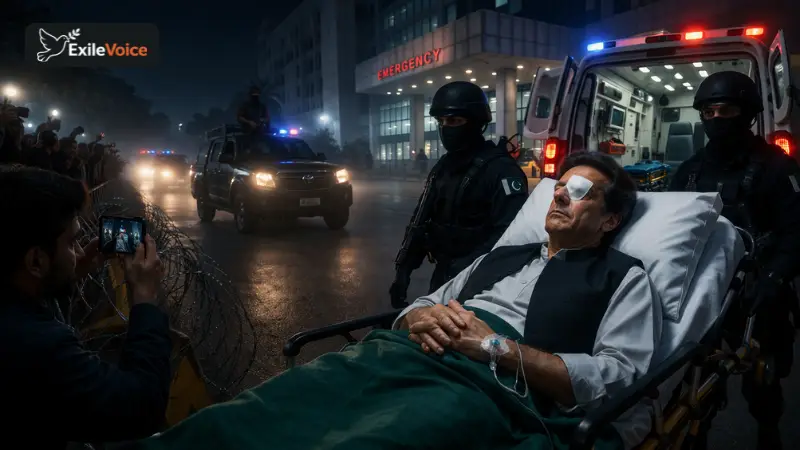
The ongoing legal and medical saga surrounding former Prime Minister Imran Khan has reached a new level of complexity following reports of his third emergency transfer to the Pakistan Institute of Medical Sciences (PIMS) Hospital. On the night between March 22nd and 23rd, 2026, Khan was reportedly moved from his place of detention to the hospital under heavy security. This recurring medical emergency, specifically concerning a persistent eye ailment, raises significant questions regarding the transparency of prisoner care and the adherence to judicial protocols within the current Pakistani political landscape.
According to insider reports, the security measures during this latest transfer were unprecedented. Hospital staff were largely replaced for the duration of the visit, and lights were extinguished in various sectors of the facility to maintain total secrecy. Khan was reportedly administered an injection intended to reduce swelling in the eye. However, the controversy lies not just in the treatment itself, but in the process. Khan’s personal physicians and family members claim they were neither notified nor consulted regarding the procedure. Medical experts cited in the analysis suggest that while the current treatment manages symptoms, alternative protocols could potentially preserve more of his vision, options that remain unexplored due to the unilateral control exercised by state authorities.
This medical situation serves as a flashpoint for broader legal criticisms. In a recent communication, Khan addressed the judiciary, urging them to examine the treatment of political prisoners and their families. He specifically highlighted the case of his wife, who, despite having no formal political role, remains embroiled in legal challenges. This "judiciary-as-a-shoulder" critique suggests that the courts are being leveraged to validate executive actions rather than serving as an independent check on power.
Furthermore, the "insider story" reveals a crackdown on transparency. A young man named Hyder, who filmed the security convoy during a previous hospital visit, remains incarcerated, with his bail repeatedly denied. This serves as a stark reminder of the risks associated with independent reporting in the current climate. The intersection of Khan’s deteriorating health and the perceived judicial silence creates a volatile narrative that continues to define Pakistan’s internal stability.

