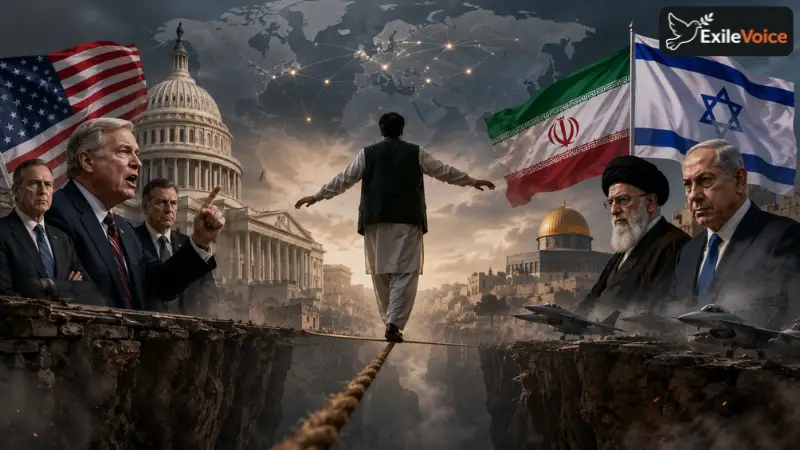
The fragile corridors of international diplomacy are witnessing a sharp, calculated shift in tone regarding Pakistan’s strategic placement between Washington and Tehran. For months, Islamabad has quietly played the delicate role of a backstage intermediary, leveraging its unique geographical and diplomatic proximity to Tehran to facilitate backchannel communications with the United States. However, recent developments emerging from Capitol Hill indicate that this high-stakes balancing act has run into a formidable wall of resistance, orchestrated by powerful right-wing lawmakers and an increasingly aggressive pro-Israel lobbying apparatus in Washington.
At the center of this gathering storm is Senator Lindsey Graham, a heavyweight in the United States Senate, a ranking member of critical committees, and a fiercely influential ally of former President Donald Trump. Graham has recently launched an overt, public campaign questioning Pakistan’s integrity as a neutral arbiter. The political ammunition for this assault was inadvertently provided by Pakistan’s own Defence Minister, Khawaja Asif. A video statement from the veteran Pakistani politician viralized across international spaces, wherein he asserted that Israel simply cannot be trusted within the framework of any regional peace process.
While Asif’s stance mirrors the long-standing, official state policy of Pakistan, a country that has never recognized the state of Israel, the timing and public delivery of the remarks allowed Washington hawk-liners to weaponize the narrative. Senator Graham responded with an extensive, highly critical public letter, explicitly stating that Pakistan’s actions are "more than problematic." Graham did not merely stop at words; he actively engineered a congressional hearing designed to scrutinize Islamabad's dual-track foreign policy.
Central to the grievances aired on Capitol Hill is the highly sensitive intelligence report alleging that Iranian state and military aircraft have been permitted to utilize or find protection at Pakistani airbases. To the right-wing establishment in Washington, this constitutes a profound betrayal of trust. The narrative being aggressively pushed across the American legislative branch paints Pakistan as a duplicitous actor, accepting Western economic backstops while simultaneously shielding the assets of a major regional adversary.
This political friction has been rapidly amplified by Indian and Israeli media outlets, which have seized upon Graham’s statements to construct a broader narrative of Pakistan as an untrustworthy global player. Headlines across New Delhi and Tel Aviv have consistently questioned whether a state facing severe internal economic turmoil should be permitted to act as a regional mediator. This systematic media pressure serves a deeper strategic purpose: forcing Pakistan into a defensive diplomatic posture.
The immediate objective of this coordinated political and media pressure is to corner Islamabad regarding the Abraham Accords. Powerful factions within Washington are seeking to issue a tacit ultimatum to Pakistan's civilian and military leadership: clarify whether the state will continue its alignment with regional revisionist powers or pivot toward the Western-backed normalization grid in the Middle East. As the rhetorical temperature rises in Washington, Pakistan's backchannel diplomatic efficacy hangs in a highly precarious balance, proving that in modern geopolitics, the role of a mediator is often the most dangerous position to occupy.