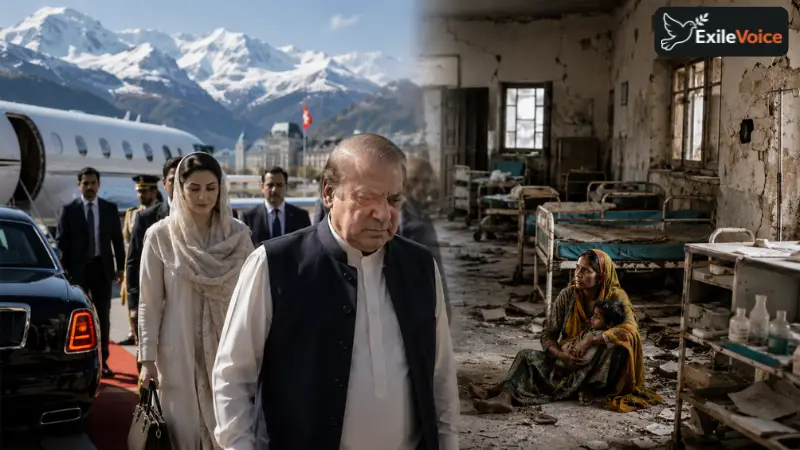
The shifting landscape of Pakistani politics has long been characterized by a stark dichotomy between the ruling elite and the common citizenry, particularly regarding public services and healthcare. The recent departure of Pakistan Muslim League-Nawaz (PML-N) supremo Mian Muhammad Nawaz Sharif to Geneva, Switzerland, ostensibly for medical consultations, serves as a poignant focal point for a broader analysis of governance, political messaging, and the systematic dismantling of public healthcare infrastructure.
According to senior journalists and reports emerging from Lahore, Nawaz Sharif’s trip follows a series of carefully managed political narratives regarding the health of the ruling family. Weeks prior, public relations efforts suggested that Punjab Chief Minister Maryam Nawaz was advised by doctors to seek complex surgery abroad. However, insular political insiders reveal a different reality. Historical precedents during Nawaz Sharif’s incarceration at Kot Lakhpat Jail show that a highly specialized medical board composed of senior professors, surgeons, and cardiologists had certified that Pakistan possesses the full technical capability to execute advanced cardiac procedures. The persistent narrative requiring foreign medical intervention is less about clinical necessity and more about crafting a specific political persona, drawing parallels to popular political figures to capture public sympathy.
While the political leadership retains the luxury of traveling to elite European medical centers on state-funded resources, encompassing aviation fuel, parking fees, and logistical support paid for by the taxpayer, the domestic healthcare landscape tells a radically different story. The current administration has overseen a aggressive rebranding of basic health units (BHUs) across rural Pakistan, overlaying them with political imagery while leaving the actual facilities unstaffed, underfunded, and devoid of basic pharmaceutical supplies.
More critically, this political transition has resulted in the systematic rolled-back of the Sehat Sahulat Card (Universal Health Insurance Card). Originally conceptualized under the previous Pakistan Tehreek-e-Insaf (PTI) administration by health ministers like Dr. Yasmin Rashid and Dr. Faisal Sultan, the program had successfully brought top-tier private hospitals onto a state-funded panel, granting impoverished citizens up to 1 million rupees in annual medical coverage. Insiders and leaked communications reveal that the closure of this program was driven primarily by a political desire to erase the legacy of the previous regime, rather than fiscal prudence. While Khyber Pakhtunkhwa has maintained the program through regional autonomy, the rest of the country faces a widening healthcare gap, leaving the vulnerable with a decorative but non-functional public healthcare network while the leadership seeks solace in Swiss clinics.