The internal security matrix of Pakistan is undergoing a profound structural shift, marked by a sophisticated escalation in the Balochistan insurgency. Recent media releases from the Baloch Liberation Army (BLA) highlight a significant tactical evolution: the active deployment of fully trained, technologically equipped female combatants and operational commanders within their asymmetric campaign. This development challenges traditional paradigms of regional security and signals a deeper institutionalization of the conflict.
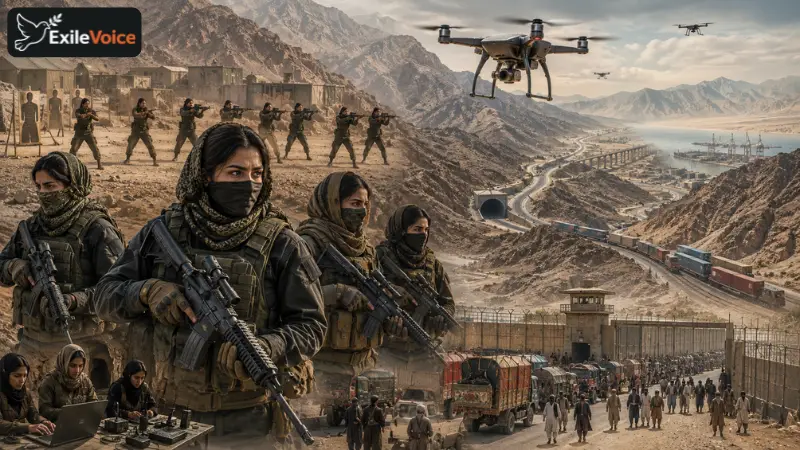
Historically, the separatist movement in Balochistan operated as a traditional, male-dominated tribal insurgency. Early waves of conflict relied primarily on rural ambushes, sabotage of infrastructure, and low-intensity skirmishes. However, the contemporary iteration of the conflict has adopted modern, highly disciplined infantry doctrines. Footage vetted by defense analysts reveals female units executing advanced close-quarters battle (CQB) drills, complex weapon handling, and synchronized turn-and-fire maneuvers. These fighters are no longer relegated to secondary logistics or intelligence roles; they are serving as frontline fداییین (fidayeen) and tactical leaders.
The modernization of the insurgent arsenal further complicates the security landscape. Combatants are frequently observed utilizing advanced Western military hardware, including AR-15 platforms and M1 rifles, alongside sophisticated drone technology used for reconnaissance and kinetic strikes. This level of weapon proficiency points to structured, professional training camps operating beyond the immediate reach of federal law enforcement.
From a counter-insurgency perspective, the integration of women into active combat roles represents a critical inflexion point. Global military history indicates that when an insurgency transcends gender boundaries and incorporates a civilian society's domestic core, the conflict becomes exponentially more difficult to neutralize. This dynamic was notably observed in the Sri Lankan civil war, where the Liberation Tigers of Tamil Eelam (LTTE) utilized dedicated female wings to sustain a multi-decade asymmetric war. A similar pattern is visible in the long-standing civil unrest in Manipur, India. When women willingly leave traditional roles within a conservative societal framework to join militant factions, the ideological commitment within the insurgent base deepens, making political reconciliation more elusive.
This internal escalation directly impacts Pakistan's broader geopolitical strategy. The primary theater of this modernized insurgency runs directly along the Pakistan-Iran border, slicing through the infrastructure networks of the multi-billion-dollar China-Pakistan Economic Corridor (CPEC). Federal authorities have previously downplayed the movement’s operational capacity, framing it as a low-level law and order issue manageable by local police forces. However, the scale, coordination, and propaganda quality of recent insurgent activities tell a different story.
The operational reality in Balochistan is further complicated by compounding border vulnerabilities. To the north, the long-standing closure of the Chaman border gate connecting Balochistan’s Pashtun belt to Spin Boldak, Afghanistan, has recently broken down. The sudden, uncoordinated opening of this major transit point led to a massive, chaotic influx of travelers across the border. While local economies rely heavily on this cross-border trade, security officials express deep concern that such unmonitored openings create vulnerabilities, allowing saboteurs, intelligence operatives, and militant actors to bypass federal screening networks.
As Pakistan’s federal leadership focuses its energy on high-profile international mediation and securing advanced defense hardware abroad, the domestic security environment demands a reassessment. Counter-insurgency strategies relying purely on kinetic containment are proving insufficient against an adversary that is rapidly modernizing its tactics, diversifying its combat demographics, and exploiting regional border friction.