The ongoing conflict in the Middle East has entered a grueling phase that many analysts describe as a "boxing match without a knockout." After more than 32 days of intense hostilities involving regional powers, the lack of a clear victor has shifted the focus from the battlefield to the diplomatic arena. However, the primary challenge remains the absence of a "referee", a credible mediator capable of enforcing a ceasefire and bringing the warring parties to the table.
Pakistan has recently positioned itself as a potential mediator, acting as a "go-between" or "messenger" between various factions, including Iran and Western interests. Historically, Pakistan has excelled in back-channel diplomacy, notably facilitating the 1971 opening between the United States and China and, more recently, aiding negotiations between the U.S. and the Taliban in Qatar. Despite these credentials, the current geopolitical weight of Islamabad alone is insufficient to command the authority required for a definitive resolution in the current crisis.
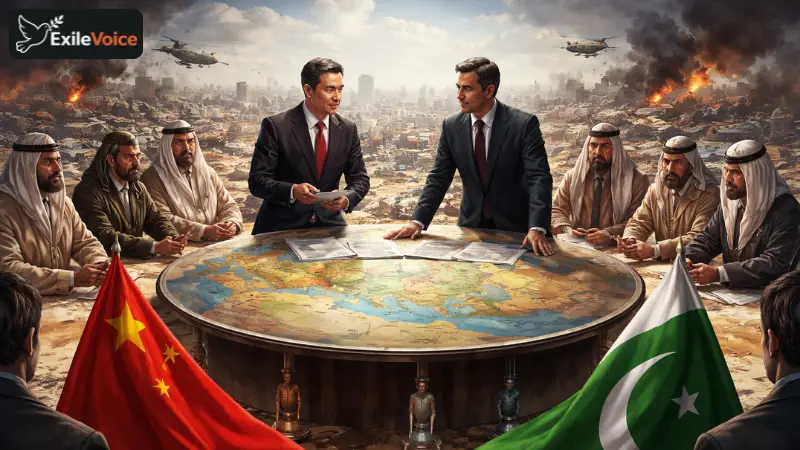
The situation has taken a significant turn with the involvement of China. During Deputy Prime Minister Ishaq Dar’s recent visit to Beijing, the narrative shifted from unilateral mediation to a joint strategic front. Iran has reportedly demanded that China serve as a "guarantor" for any future peace agreements, distrusting the inconsistent policies of the Western powers. China, known for its "patient diplomacy" and strategic stability, offers a heavyweight alternative to the "unhinged" and "hot-and-cold" nature of current U.S. foreign policy under the Trump administration.
Together, Pakistan and China have proposed a five-point framework for regional stability:
- Immediate Cessation of Hostilities: An urgent call to stop all military actions to prevent further loss of life.
- Sovereignty and Territorial Integrity: Emphasizing the independence of Iran and Gulf states as a cornerstone for peace.
- Protection of Non-Military Targets: Demanding an end to attacks on civilian infrastructure, such as ports, airports, and energy fields.
- Security of Maritime Trade: Ensuring the Strait of Hormuz remains open to safeguard the global economy from soaring oil prices.
- Primacy of International Law: Reasserting the role of the UN and humanitarian laws in conflict resolution.
This joint initiative marks a "brilliant move" for Pakistan, as it leverages China’s global influence to provide the "muscle" that Islamabad’s diplomacy lacks on its own. As the world watches, the success of this partnership depends on whether they can convince an increasingly fractured West to accept a new diplomatic order in the region.