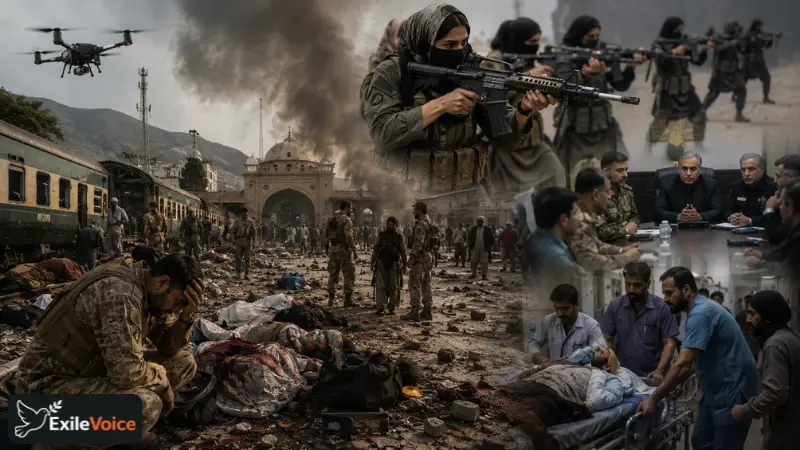
A devastating suicide bombing at the Chaman Phatak railway station in Quetta has underscored the deteriorating internal security situation within Pakistan. The powerful explosion, which targeted a crowd of passengers preparing to travel for festive holidays, resulted in at least thirty fatalities and left over a hundred individuals wounded. The impact of the blast was so massive that local reports indicated the sound could be heard miles away from the epicenter. The Baloch Liberation Army, a banned separatist group, quickly claimed responsibility for the attack.
An analysis of the official casualty lists reveals a poignant socio-economic narrative that highlights the changing dynamics of the conflict. The victims consisted primarily of lower-ranking personnel, including Junior Commissioned Officers, regular soldiers, non-commissioned officers, and their families, who were traveling via the public railway network. Branches affected included signals, ordnance, artillery, and electrical engineering units, notably from the 33rd Division. Conspicuously absent from these passenger lists were high-ranking military officers, who typically utilize private aviation or secure, high-level transport. This disparity underscores that the frontline human cost of this asymmetric warfare continues to be borne almost entirely by working-class soldiers and civilians.
Beyond the immediate human tragedy, the operational capabilities of the separatist elements have demonstrated a sophisticated evolution. The group recently released a highly produced propaganda video showcasing the operational role of its female wings, exemplified by commanders such as Shahnaz Baloch. The visual evidence reveals advanced infantry drilling, including complex Close Quarters Battle maneuvers, fluid "turn and fire" tactical movements, and adept weapon handling.
Furthermore, the weaponry utilized has shifted from rudimentary firearms to sophisticated, modern hardware, including American-manufactured M1 rifles, AR-15 variants, and commercial surveillance drones. This represents an unprecedented structural upgrade in tactical communication and logistical planning. Historical precedents in South Asia show that when a militancy successfully integrates women into its frontline combat and tactical leadership cadres, the structural longevity of the insurgency increases dramatically. This pattern mimics historical dynamics observed during the decades-long campaign of the Liberation Tigers of Tamil Eelam in Sri Lanka and localized conflicts in Manipur, India. Unlike religiously motivated networks such as the Taliban, these secular, separatist frameworks rely heavily on localized, communal ties where conflict is embedded within the socio-political fabric of communities.
The response from public officials has drawn sharp domestic criticism, highlighting a disconnect between administrative leadership and the realities on the ground. Key leadership figures, including Federal Interior Minister Mohsin Naqvi and the provincial Chief Minister, have faced scrutiny for conducting closed-door briefings rather than visibly engaging with victims at hospital sites. This governance gap occurs at a time when the state is struggling to counter a highly coordinated insurgent strategy that executed approximately eighty simultaneous strikes across Balochistan just a month prior. The expanding tactical capability of these groups indicates that standard localized policing or viewing the challenge solely through the lens of external proxy warfare is insufficient to handle the evolving threat matrix.