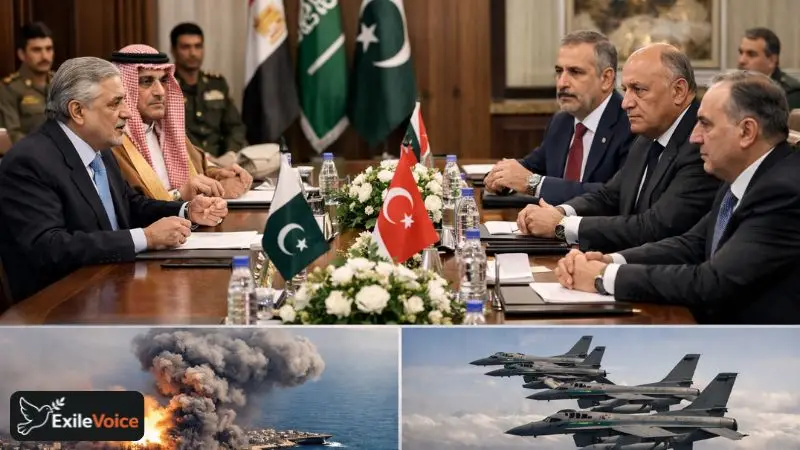
In a significant but shrouded diplomatic move, Islamabad recently played host to a four-hour quadrilateral meeting involving the foreign ministers of Pakistan, Saudi Arabia, Turkey, and Egypt. While the Pakistani government, led by Foreign Minister Ishaq Dar, has framed this summit as a peace-building initiative aimed at de-escalating the growing conflict between the United States and Iran, regional analysts and international observers are questioning the true efficacy of these talks. The presence of high-profile figures such as Saudi Foreign Minister Prince Faisal bin Farhan Al Saud and Turkey’s Hakan Fidan underscores the gravity of the West Asian crisis, yet the lack of a joint statement following four hours of deliberation suggests a lack of consensus or a focus on private strategic alignment rather than public diplomacy.
The timing of this summit is particularly sensitive as the Trump administration intensifies its military posture in the Persian Gulf. Dr. Moeed Pirzada highlights a glaring discrepancy in how these meetings were conducted. While bilateral meetings took place between Prime Minister Shehbaz Sharif and the visiting ministers, the session with Saudi Arabia notably included Pakistan’s Director General of Inter-Services Intelligence (ISI) and National Security Advisor, General Asim Malik. This inclusion was absent in the meetings with Turkish and Egyptian counterparts, signaling a distinct, high-level strategic "special relationship" between Islamabad and Riyadh regarding the Iranian theater that is not shared with the other participants.
From the Iranian perspective, these diplomatic maneuvers are viewed with extreme skepticism. Bagher Ghalibaf, the Speaker of the Iranian Assembly, has dismissed these talks as a "smoke screen." In Tehran’s view, the public discourse regarding negotiations in Islamabad serves as a diplomatic cover while the U.S. military proceeds with its "softening" of Iranian defenses through heavy bombardment of coastal facilities. The Iranian leadership maintains that while the world discusses peace in Islamabad, five-thousand-pound bombs are being dropped on Iranian naval and anti-ship missile facilities along the Strait of Hormuz to prepare for a potential ground or amphibious assault.
Furthermore, the role of Pakistan as a mediator is complicated by its own internal and external pressures. While Ishaq Dar has hinted at a possible face-to-face meeting between U.S. and Iranian officials on Pakistani soil in the coming days, no confirmation has arrived from Washington or Tehran. The narrative being pushed by the Pakistani and Saudi axis appears to be one of "facilitating the U.S. agenda" to bring a recalcitrant Iran to the table. However, without Iranian participation or a clear "off-ramp" for the Trump administration, these talks risk being remembered as a footnote in a march toward a much larger confrontation.