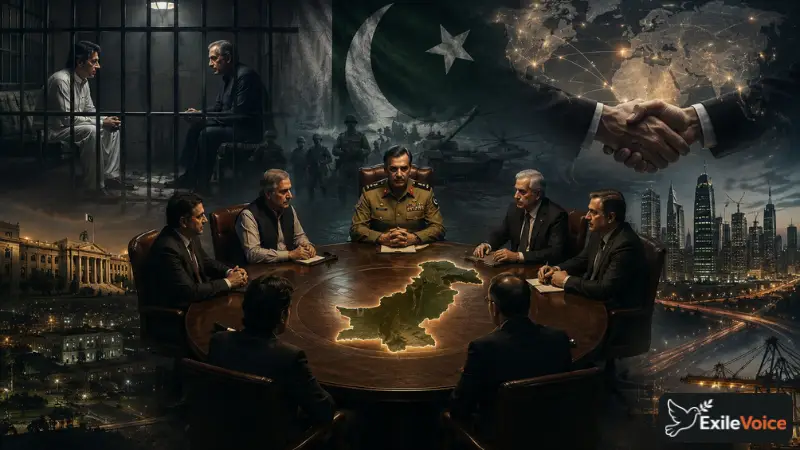
The political landscape of Pakistan remains an intricate tapestry where institutional power, covert negotiations, and orchestrated leaks intersect to shape national policy. Recent public discourse has been saturated with reports concerning unprecedented backchannel communications, notably rumors suggesting a high-profile meeting inside a detention facility between former Prime Minister Imran Khan and former Chief of Army Staff General Ashfaq Parvez Kayani. While close associates of General Kayani point out that the 75-year-old retired general lives a reclusive life due to health constraints, the structural utility of these rumors warrants deep analytical scrutiny. In a country where public perception is closely tethered to military dynamics, the circulation of such high-level mediation stories is rarely accidental. Instead, it frequently points toward an underlying effort by domestic actors to test public sentiment, gauge institutional reactions, and prepare the domestic environment for impending political developments.
The strategic landscape indicates that despite nominal civilian control under the ruling coalition, institutional leverage remains firmly consolidated within the military command under General Asim Munir, with specific technocratic and administrative executees like Mohsin Naqvi managing critical foreign and domestic portfolios. This consolidation occurs alongside apparent administrative shifts within the traditional political parties, as evidenced by growing internal complaints regarding basic service delivery, infrastructural breakdowns, and restricted operational space for senior politicians. Consequently, the dissemination of narratives concerning institutional dialogue with the incarcerated opposition serves a dual purpose. It aims to lower the political temperature domestically while projecting an image of stability and reconciliation to international financial institutions and global allies who demand long-term predictability before committing substantial capital.
Furthermore, this forward planning by state institutions is increasingly linked to massive shifts in regional and global alignments. Intelligence and diplomatic analysts suggest that the state's strategic apparatus is laying down the communicative infrastructure required to navigate upcoming global pressures, particularly the anticipated enforcement of wide-ranging multinational diplomatic treaties such as the Abraham Accords under potential shifting global administrations. Historically, Pakistan has buffered itself against controversial diplomatic maneuvers by aligning its policies with powerful regional partners like Saudi Arabia. However, as these partner nations look toward deep-set modernization, economic diversification, and conditional recognition of new regional configurations, Pakistan’s state managers are recognizing that they cannot rely on traditional shields indefinitely. The crafting of an internal environment where all political factions are seen as part of a grand compromise ensures that if catastrophic or highly sensitive foreign policy shifts are required in the medium term, the responsibility can be distributed across a broad national consensus, thereby shielding any single institution from popular backlash.