

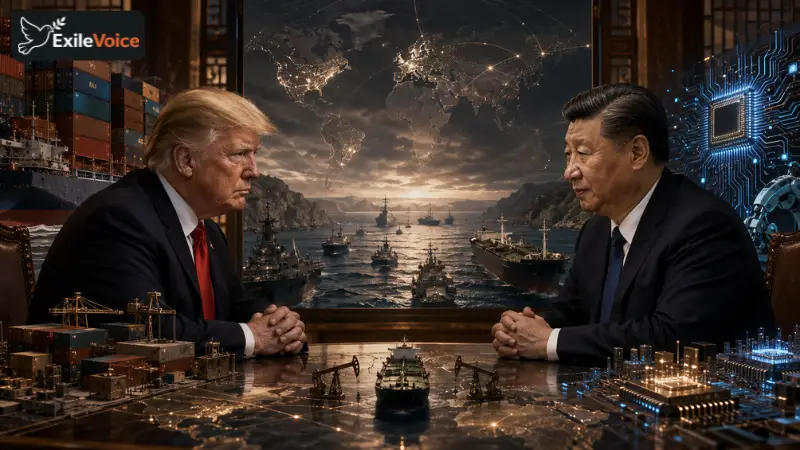
The global geopolitical landscape is currently fixated on Beijing as United States President Donald Trump arrives for a high-stakes summit with Chinese President Xi Jinping. This meeting represents more than just a diplomatic visit; it is a confrontation between two distinct "Imperial Orders". As the world watches, the agenda is dominated by what analysts are calling the "Three Ts": Trade, Technology, and Tehran.
On the trade front, discussions aim to navigate increasingly protectionist stances and the complex supply chains that bind these two economic giants. Technology transfer remains a friction point, particularly concerning high-end semiconductors and artificial intelligence. The presence of NVIDIA's CEO in the American delegation underscores the critical nature of these talks. China, for its part, holds a significant "choke point" over the U.S. through its control of rare earth minerals, which are essential for modern technology and defense.
However, the most immediate and volatile issue is Iran. Despite President Trump's public assertions that he does not need China's help to handle the "Iran problem," American intelligence and military analysts agree that Beijing's cooperation is indispensable. The U.S. is facing a stark reality: despite claims of having crippled Iranian missile capabilities, intelligence suggests that nearly 70% to 80% of Iran's mobile launchers and coastal defense systems remain intact and operational.
Adding to the complexity is a recent UN Security Council resolution passed under Chapter VII. Surprisingly, Russia and China did not exercise their veto power, allowing a resolution that demands Iran cease attacks on maritime trade and mine-laying in the Strait of Hormuz. While this provides a legal "right of defense" for the U.S. and its allies, it does not grant automatic authorization for the use of force. Instead, it sets a 30-day review period, after which any military escalation would require further consultation.
This diplomatic maneuver suggests a strategic recalibration. China may use its influence to urge Iran to reopen the Strait of Hormuz in exchange for a removal of the U.S. naval blockade. However, for Iran, such a deal would be hollow without economic relief or the unfreezing of assets. Without these concessions, the Iranian regime faces a precarious future, trapped between international legal pressure and a domestic economic crisis.