

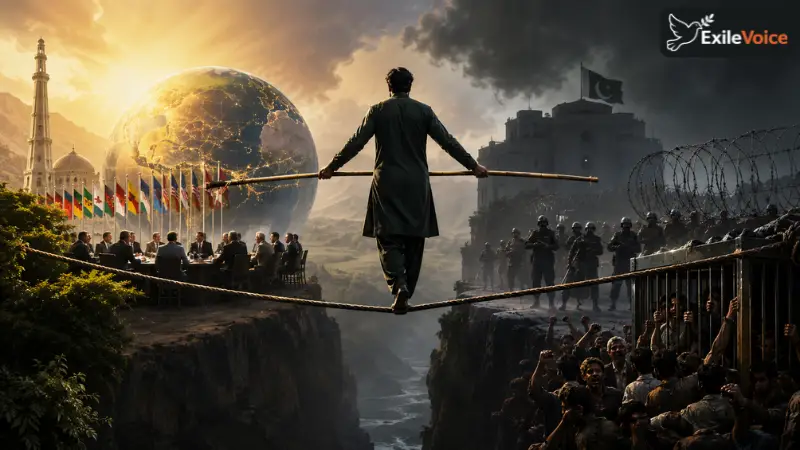
Pakistan’s recent diplomatic agility in international mediation has brought the country's broader foreign policy trajectory under renewed scrutiny. While the state has proven highly capable of executing complex external negotiations, it remains tethered to deep-seated ideological positions, most notably regarding the State of Israel, that critics argue limit its potential as a serious, long-term partner in the global arena.
The tension between Pakistan’s external diplomatic successes and its internal ideological framework creates a unique paradox. For decades, Pakistan’s stance on Israel has been characterized by a uniform ideological opposition that transcends domestic social strata, from secular elites to conservative factions. While some defend this as a reflection of the national moral consciousness, others, such as geopolitical analysts, view this rigid stance as a symptom of a broader externalization of internal failures. The argument follows that when a nation struggles with internal governance, educational crises, and economic instability, it often leans on external causes to build national cohesion.
This "ideological obsession" is frequently cited as a barrier to Pakistan’s full integration into a more pragmatic, stable international partnership with the United States. The challenge for policymakers in Islamabad is whether they can modernize their diplomatic posture without alienating the domestic base that views these issues as foundational to national identity.
Simultaneously, the internal governance situation in Pakistan remains dire. As the state achieves high-profile successes abroad, it continues to face severe domestic criticism regarding human rights, the treatment of political opposition, and the suppression of media voices. Observers point to the contrast where the Pakistani establishment appears as a "superman" in international forums, yet acts with heavy-handed force at home. The imprisonment of political figures and the silencing of dissenters create a dissonance that many Western observers find difficult to reconcile with the country's rhetoric of modernization.
The path forward for Pakistan requires a delicate balancing act. To secure a long-term, stable relationship with global powers, Islamabad must demonstrate an ability to engage in nuanced, rational conversations on contentious issues rather than relying on uniform, rigid dogma. Moreover, it must ensure that the "field marshal-prime minister" partnership, which the current U.S. administration finds "beautiful", does not come at the expense of the democratic rights of the Pakistani people. Until the state can successfully yoke its diplomatic victories to the empowerment and protection of its citizenry, these achievements may remain mere footnotes in an otherwise stagnant historical narrative.

