The recent global publication of the full, unredacted text of a highly sensitive diplomatic communication, historically referenced as the "Cipher", has sent profound shockwaves through the absolute core of Pakistan’s military establishment. For nearly three years, institutional players and political networks had aggressively maintained that the document’s contents were either exaggerated or completely fabricated for domestic political leverage. However, the physical release of the document by independent international media organizations has decisively verified its authenticity, triggering a massive institutional panic within General Headquarters (GHQ) in Rawalpindi. The primary point of concern for the high command is not merely the diplomatic fallout of the document's text, but rather the terrifying reality of a structural security breach indicating that the state's most secure intelligence and communication pipelines have been compromised from within.
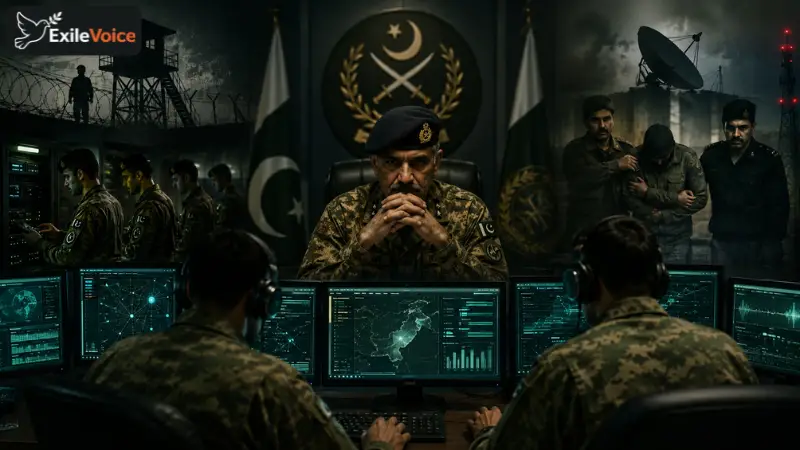
In direct response to this unprecedented leak, a specialized, high-priority counter-intelligence operation has been initiated under the personal supervision of the de facto military ruler, Field Marshal Asim Munir. Reliable military sources confirm that the 408th Military Intelligence (MI) Battalion, an elite unit that bypasses standard regional commands to report directly to the office of the Chief of Army Staff, has been fully mobilized. In a series of emergency administrative deployments, the Officers Commanding (OCs) of MI units stationed across strategic regional bases, including Sialkot, Mangla, Kharian, and Gujranwala, were abruptly recalled to Rawalpindi. This rapid consolidation of counter-intelligence assets marks the launch of one of the most aggressive internal surveillance operations in the history of the armed forces, aimed at unearthing the precise paper and electronic trail of the leak.
The investigative apparatus has established a major cyber surveillance program that directly targets high-ranking military officers both inside and outside GHQ. Operating under the code name "425 Operation Battalion," specialized electronic warfare units have begun a comprehensive audit of communication devices. This program involves the systematic collection and verification of International Mobile Subscriber Identity (IMSI) codes and International Mobile Equipment Identity (IMEI) numbers belonging to senior officers, as well as an extensive surveillance dragnet covering the telecommunication networks of their immediate family members. Furthermore, the military's private secure phone network, known administratively as "PASOM," has been placed on high-alert monitoring status, with all encrypted voice calls and data logs subjected to real-time algorithmic screening for anomalies.
The structural tension reached a critical peak when specialized MI teams conducted an unannounced internal inspection at the headquarters of the Inter-Services Intelligence (ISI) in Islamabad. This extraordinary step resulted in the formal initiation of an unknown internal inquiry against two high-ranking ISI officers and a senior Non-Commissioned Officer (NCO) serving as an inspector. Preliminary assessments by independent investigative journalists suggest that the document was deliberately leaked by a highly disgruntled faction within the officer corps, individuals who are deeply dissatisfied with the military's aggressive involvement in domestic political engineering, the systematic suppression of democratic norms, and the enforcement of the controversial "Form 47" legislative mandate.
By executing a highly calculated leak to global media networks, these internal dissidents have completely shattered the illusion of institutional unity. As the MI continues its aggressive sweep, the expanding internal crackdown confirms that the primary threat to the current military high command is no longer found among external adversaries, but within a deeply fractured and ideologically divided domestic officer corps.