The public healthcare system of Punjab is currently navigating a profound structural crisis characterized by acute funding deficits, severe supply chain blockages, and a widening chasm between administrative priorities and clinical realities. While public hospitals serve as the primary safety net for tens of millions of citizens, the infrastructure is bucking under the weight of hyper-inflated patient volumes and drastically reduced operational budgets. A deep systematic evaluation of major healthcare installations across cities like Rawalpindi and Lahore exposes a pattern of institutional neglect where life-saving resources are systematically starved to accommodate superficial, high-visibility populist projects.
At the heart of this crisis is a staggering mismatch between requested operational budgets and the actual capital released by the provincial treasury. Landmark tertiary healthcare facilities, including the Holy Family Hospital, the Benazir Bhutto Hospital, and the Rawalpindi Teaching Hospital, find their free medicine initiatives on the verge of complete collapse. Historical financial tracking indicates that while administrative bodies calculated a bare minimum requirement of forty-five billion rupees to sustain essential pharmacological supplies across the province, the state apparatus intentionally approved and disbursed a mere twenty-five billion rupees. This massive shortfall leaves frontline facilities missing nearly half of their required baseline medical supplies.
This massive funding deficit translates to a daily reality of systemic deprivation for the civilian population. Essential life-saving drugs, chemotherapy agents, baseline antibiotics, and standard post-operative emergency care items are completely exhausted from public pharmacy shelves. When administrative departments petition for crucial sub-allocations, they are met with minor, single-digit fractional disbursements that fail to cover even a single week of high-density patient inflow. Consequently, impoverished patients are forced to procure their own basic clinical consumables from predatory private vendors operating on the peripheries of state institutions, rendering the concept of universal state healthcare entirely non-functional.
As state systems fail to provide basic infrastructure, the brunt of public outrage is directed at the medical community. Pakistani medical professionals endure a rigorous academic and clinical pipeline, spending years surviving underpaid house jobs, exhausting thirty-six-hour shifts, and working within intensely under-equipped public wards. Despite their world-class capabilities, which are recognized internationally across prestigious healthcare institutions in the United Kingdom and North America, local doctors are left to operate within high-stress zones entirely devoid of essential tools, functional beds, or administrative security.
This systemic failure breeds extreme workplace volatility. Families facing tragic outcomes due to a lack of equipment or medicines frequently turn their grief and frustration against the nearest available targets: the resident doctors and nursing staff. Incidents of workplace violence, verbal abuse, and physical altercations have escalated significantly across major municipal wards. Starved of resources, underpaid, and facing constant physical danger, the state’s finest medical minds are fleeing the country in historic numbers. This accelerating brain drain permanently strips local tertiary centers of vital clinical expertise, locking the public healthcare architecture into a tailspin of declining standards and institutional decay.
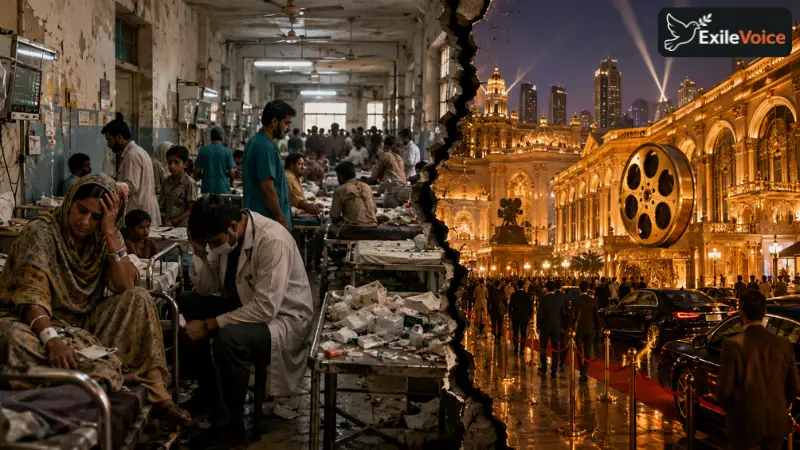
The structural continuation of this healthcare collapse is driven by a deep distortion of governance priorities within the provincial administration. In a striking display of policy misdirection, hundreds of billions of rupees are diverted from critical human development sectors, such as primary healthcare, emergency services, and basic public school infrastructure, to fund superficial, high-visibility vanity projects. The reallocation of over thirty-five billion rupees toward the creation of luxury entertainment hubs and state-backed "Film Cities" underscores a political philosophy that prioritizes narrative distraction over civic survival.
This systemic neglect represents a strategic calculation by administrative entities to trade long-term societal health for short-term media spectacles and public relations victories. While regional intensive care units run out of life-saving medicines and pediatric wards are forced to double up patients on single, broken beds, state funding flows freely into entertainment zones and digital media campaigns. This stark contrast highlights a profound ethical breakdown in public governance, where the basic biological survival of vulnerable citizens is compromised to fund political imagery and manufactured distractions.