The fragile scaffolding of Middle Eastern diplomacy has suffered a catastrophic fracture. Behind-the-scenes peace negotiations aimed at securing a comprehensive ceasefire between Iran and Western allies have officially collapsed. The suspension of these high-stakes talks, which had been quietly mediated by Pakistan for weeks, underscores the volatile nature of a conflict that now threatens to spill over completely into Lebanon.
The immediate catalyst for the collapse was a sharp escalation of hostilities by Israeli forces, culminating in aggressive military positioning near the Lebanese capital of Beirut. This development triggered intense diplomatic fallout across Washington, Islamabad, and Jerusalem, completely upending a delicate, unwritten draft agreement colloquially dubbed the "Butta Accord."
According to Iranian Foreign Minister Abbas Araghchi, Iran chose to formally suspend the negotiation tracks due to repeated, systemic violations of ceasefire understandings by Tel Aviv. The diplomatic anger peaked when Chief Negotiator Vali Bab, who had recently visited Islamabad to finalize draft frameworks, warned that "every choice has a price," pointing to Israeli blockades and war crimes in Lebanon as proof that western-backed entities were operating in bad faith.
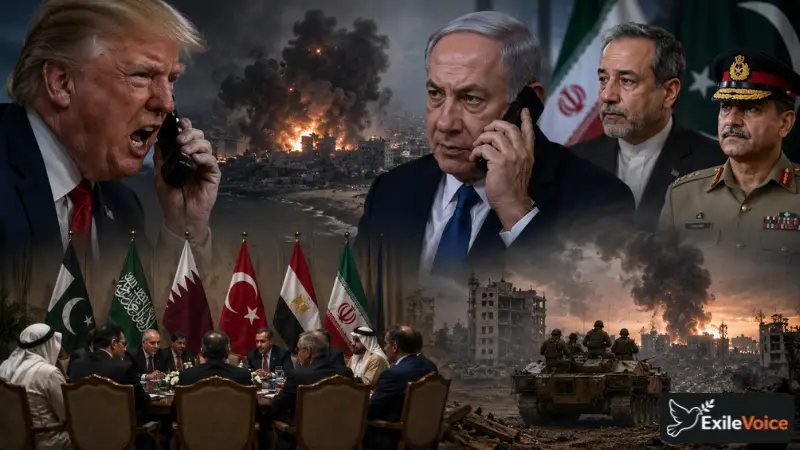
As the situation deteriorated, U.S. President Donald Trump made a desperate, public attempt at damage control via his platform, Truth Social. Trump claimed he had spoken directly with Israeli Prime Minister Benjamin Netanyahu, instructing him to halt the advance on Beirut, and asserted that Hezbollah had agreed to refrain from targeting Israeli troops.
However, behind that sanitized public statement lay an incredibly volatile reality. High-level journalistic leaks confirmed that Trump engaged in one of the most profane, furious phone calls of his political career with Netanyahu. Sources report that Trump explicitly berated the Israeli Prime Minister, shouting that he had single-handedly "ruined everything" and highlighting that the entire global community now harbors deep resentment toward Israel’s unchecked military operations. Trump openly reminded Netanyahu of his dependency on American political survival, stating that without U.S. interventions, the Israeli leader would likely be facing imprisonment. Trump’s immense anger stems from a pragmatic political calculus: the ongoing war is devastating his domestic approval ratings, driving inflation, destabilizing the stock market, and causing oil prices to spike, all while threatening his core voter base.
The tragedy of the collapse lies in how close backchannel mediators had come to a breakthrough. For months, Pakistan’s military leadership, under Chief of Army Staff General Asim Munir, had positioned Islamabad as the vital, trusted interlocutor between Washington and Tehran. Because both sides explicitly trusted the Pakistani backchannel, military and intelligence officials had spent weeks meticulously hammering out a delicate, highly confidential text. This mediation framework was built in alignment with regional heavyweights, including Saudi Arabia, Qatar, Egypt, and Turkey, purposefully excluding Israel from the room to prevent immediate spoilers.
Netanyahu’s aggressive pivot toward Beirut is widely interpreted by intelligence analysts as an act of political self-preservation. As an unpopular leader facing active domestic corruption trials and a fiercely competitive political opposition, Netanyahu requires a state of perpetual, multi-front warfare to justify his political survival. By ignoring Trump’s directives and launching an unauthorized expansion into Lebanon, Netanyahu effectively sabotaged a peace process where he lacked a signature, ensuring that the structural rubble of the collapsed talks would fall squarely on his geopolitical rivals while extending his lease on power.