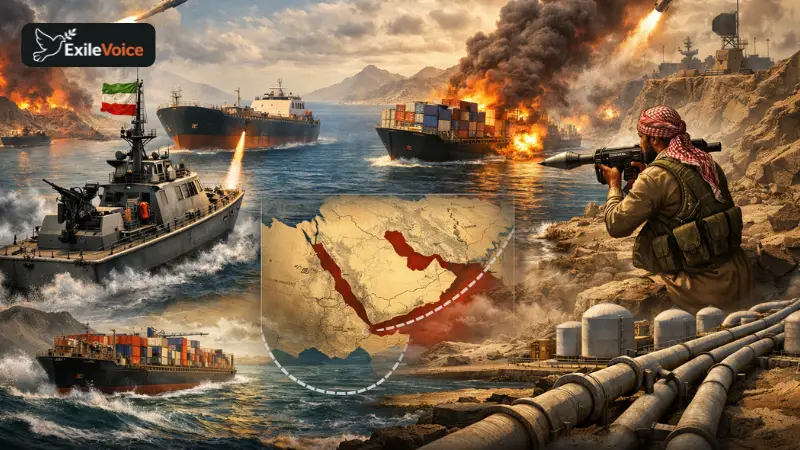
The geopolitical landscape of the Middle East is undergoing a seismic shift as Iran executes a sophisticated "economic war" strategy designed to leverage its geographical advantages. Historically, the Strait of Hormuz has been the primary focus of global energy security, with approximately 20% of the world's oil supply passing through this narrow waterway. However, recent developments suggest that Iran is expanding its tactical reach to include the Bab el-Mandeb strait, effectively creating a dual-chokepoint crisis for international trade.
Iran's military doctrine has shifted from direct confrontation to a prolonged economic attrition strategy. By targeting the maritime routes that connect the Persian Gulf and the Red Sea to the global market, Tehran is not merely threatening energy supplies but is systematically increasing the cost of global commerce. When these straits are compromised, shipping companies are forced to divert vessels around the Cape of Good Hope. This detour adds approximately 18 days to a standard voyage, doubling transportation costs and fueling global inflation.
The strategic response from regional powers like Saudi Arabia and the United Arab Emirates (UAE) has centered on bypassing the Strait of Hormuz via pipelines. Saudi Arabia has invested heavily in infrastructure to move oil toward the Red Sea, while the UAE has utilized pipelines ending in Fujairah to bypass the volatile waterway. However, Iran has demonstrated its ability to neutralize these alternatives. Recent reports of strikes in Fujairah and the activation of Houthi proxies near the Bab el-Mandeb indicate that there is no "safe" bypass when regional tensions reach a boiling point.
From a professional standpoint, this is not just a regional conflict but a calculated attempt to disrupt the Western economic order. For the Trump administration and its allies, the priority remains the restoration of free navigation. Yet, the precision of Iran’s newer ballistic missile technology, demonstrated by recent strikes with 2,000km range capabilities, suggests that traditional interception methods are being tested to their limits. As long as Iran can maintain pressure on these maritime arteries, the global economy remains vulnerable to sudden, sharp inflationary shocks that no central bank can easily mitigate.