The escalation of political and economic unrest across Azad Jammu and Kashmir (AJK) in mid-2026 marks a watershed moment in the relationship between regional civil society and federal state institutions. The massive public mobilizations, coordinated under the umbrella of the Jammu Kashmir Joint Awami Action Committee (JAAC), culminated in widespread shutter-down strikes and a historic long march toward Muzaffarabad. This upheaval is not a sudden or isolated phenomenon; rather, it represents the direct fallout of historical institutional commitments left unfulfilled, combined with aggressive state actions that have only served to deepen systemic grievances.
The roots of the current crisis trace back to mid-2025, when a similar wave of popular protests forced the administrative setup and its backers within the federal establishment to negotiate. At that juncture, the action committee presented a series of core demands, primarily focused on fair electricity pricing proportional to local hydel generation costs, subsidies on wheat flour, and a substantial reduction in elite administrative privileges. Although the state formally accepted these demands to defuse immediate tensions, the subsequent ten months saw a near-total failure in execution. Instead of implementing systemic economic reforms, federal authorities chose to call for new regional electoral processes, leaving the fundamental socio-economic issues unaddressed.
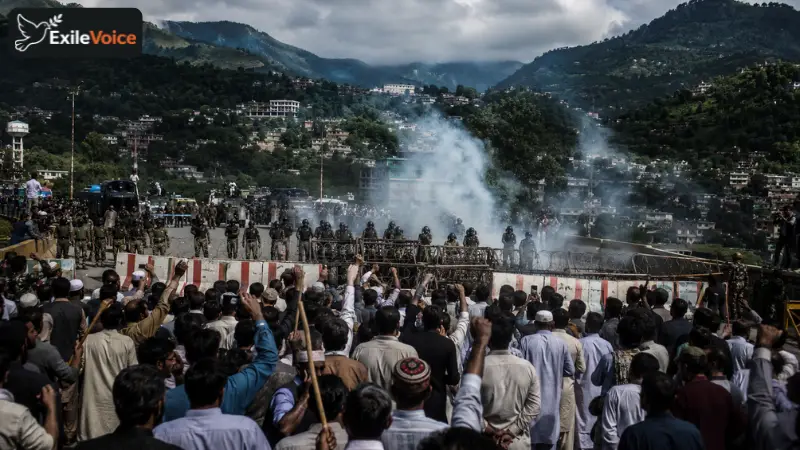
Seeing these administrative delays as a breach of contract, the action committee mobilized a renewed mandate for protests on June 9, 2026. Unlike typical political rallies in Pakistan, where crowds gather primarily when top-tier leadership arrives, the Muzaffarabad mobilization showed an inverted dynamic. Local residents did not wait for incoming caravans; instead, they proactively marched toward the city’s entry points to dismantle physical blockades erected by local law enforcement. Massive public rallies emerged from Samahni, Rawalakot, and Barnala, converging on the regional capital despite severe security measures.
The state’s tactical response to this organic movement highlights a major strategic blindspot. In high-level administrative meetings involving prime-ministerial staff, intelligence representatives, and security planners, a hardline approach was approved. This strategy sought to suppress the movement through force rather than addressing its core economic issues. The ensuing deployment of paramilitary forces, including the Pakistan Rangers alongside regional police, led to violent clashes across multiple sectors, particularly in Palandri and Bhimber. Initial reports confirmed casualties on both sides, including several security personnel and numerous unarmed civilian protesters.
From a strategic perspective, using force to handle a grassroots socio-economic movement has backfired significantly. Rather than intimidating the population, the heavy-handed state response has legitimized the action committee's platform, transforming localized economic complaints into a broader movement for civil rights and regional autonomy. Furthermore, the operational decision to execute late-night security sweeps and block local communications has alienated sections of the local bureaucracy and civil society that previously acted as stabilizing buffers.
By framing a domestic economic grievance as a security threat, federal institutions have effectively closed off avenues for sustainable political mediation. This dynamic creates a dangerous governance vacuum where public trust in state institutional frameworks is severely eroded, leaving raw administrative force as the primary mechanism of control, a model that historical precedents suggest is unsustainable over the long term.