

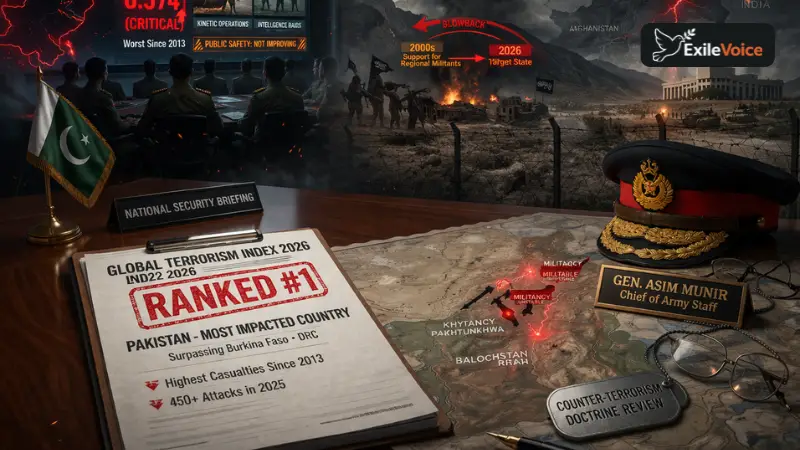
The release of the latest Global Terrorism Index (GTI) has placed Pakistan in a precarious position, ranking it as the country most impacted by terrorism globally in 2026. This ranking marks a severe deterioration in national security, with the country surpassing nations like Burkina Faso and the Democratic Republic of Congo in terms of terrorism-related casualties and frequency of attacks. The data suggests that despite numerous military operations, the security landscape is more volatile now than at any point since 2013.
The professional military leadership, led by General Asim Munir, faces intense scrutiny regarding the effectiveness of their current counter-terrorism doctrine. While official briefings often tout thousands of successful intelligence-based operations, the rising GTI score indicates a disconnect between operational volume and actual public safety. Critics argue that the military’s increasing involvement in non-security domains such as sports management, industrial production, and political engineering has diluted its focus on core defense responsibilities.
The phenomenon known as "blowback" is increasingly cited by political scientists to describe the current state of affairs. This refers to the unintended consequences of past strategic decisions, such as the long-term support for regional militant groups that have now turned their sights on the Pakistani state. The current leadership’s inability to stabilize the border regions of Khyber Pakhtunkhwa and Balochistan is viewed as a significant failure of the "hardline" approach that prioritizes kinetic force over political reconciliation.
Furthermore, the domestic political environment has become a secondary front. The military’s perceived overreach into civil administration, often referred to by critics as the "Form 47" governance model, has strained the social contract. Public trust is further eroded by allegations of "fake" credentials and a lack of transparency within the high command. As the country faces a "Number 1" ranking in global terrorism, the need for a comprehensive, multi-dimensional security policy that integrates civilian oversight and addresses the root causes of insurgency has never been more urgent.

