Pakistan finds itself in an increasingly complex and contradictory position as the Iran-U.S. conflict unfolds. On one hand, Islamabad is proudly projecting itself as a master mediator, hosting "Islamabad Talks" at the Serena Hotel where high-level discussions between American and Iranian representatives are supposedly taking place. On the other hand, the reality on the ground suggests a much more transactional role, one that critics describe as a "commission agent" for Saudi and American interests.
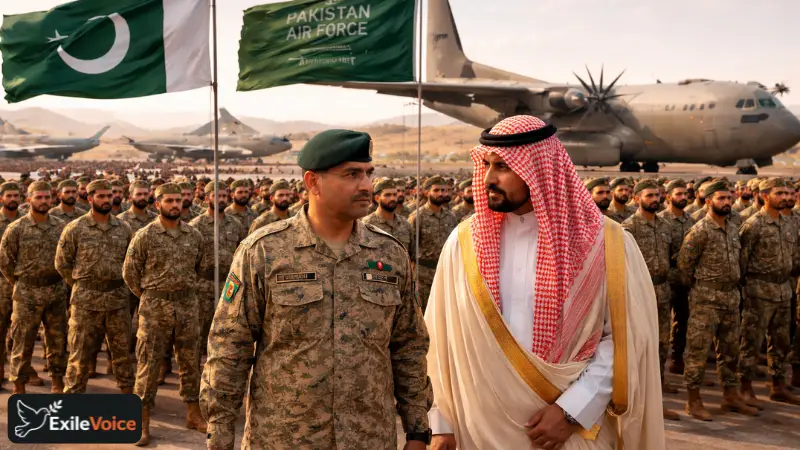
The contradiction became starkly visible when Saudi Arabia’s Ministry of Defense announced that Pakistani Air Force squadrons and approximately 13,000 soldiers had arrived at the King Abdulaziz Base. This deployment occurred exactly as Pakistan was claiming to facilitate peace between Tehran and Washington. Curiously, this massive troop movement was not officially reported by Pakistan’s Inter-Services Public Relations (ISPR) or the Foreign Office. The presence of combat-ready Pakistani troops in Saudi Arabia, a nation currently viewed as a combatant in the broader regional struggle with Iran, raises serious questions about Pakistan’s neutrality as a mediator.
The United Arab Emirates (UAE) has expressed visible frustration with this alignment. Reports suggest the UAE’s recent demand for the immediate return of $3 billion in deposits from Pakistan is a direct reaction to Islamabad’s refusal to provide similar military "contingents" to Abu Dhabi. While Pakistan maintains a Mutual Defense Act with Saudi Arabia, its refusal to extend the same security umbrella to the UAE has created a rift within its relations with Gulf allies. This military-for-money arrangement is further complicated by the praise heaped upon Pakistan’s Army Chief, General Asim Munir, by President Donald Trump, who recently referred to him as a "Field Marshal" doing an "excellent job."
Domestically, Pakistan’s economic survival remains tethered to these regional maneuvers. Finance Minister Muhammad Aurangzeb recently announced a "success" in securing a $3 billion loan from Saudi Arabia to replace the funds withdrawn by the UAE. He also noted that Saudi Arabia has extended the maturity of $5 billion in deposits until 2028. While presented as a victory, critics point out the irony of a highly respected former banking CEO celebrating the acquisition of more debt as a primary achievement.
Ultimately, Pakistan’s role in the 2026 crisis is one of high-wire diplomacy. It is attempting to leverage its military strength to secure financial lifelines from the Gulf while simultaneously positioning itself as a diplomatic bridge to Iran. Whether this "dual-track" policy is sustainable or if it will eventually alienate Tehran or Washington remains the most critical question for Pakistan’s national security.