

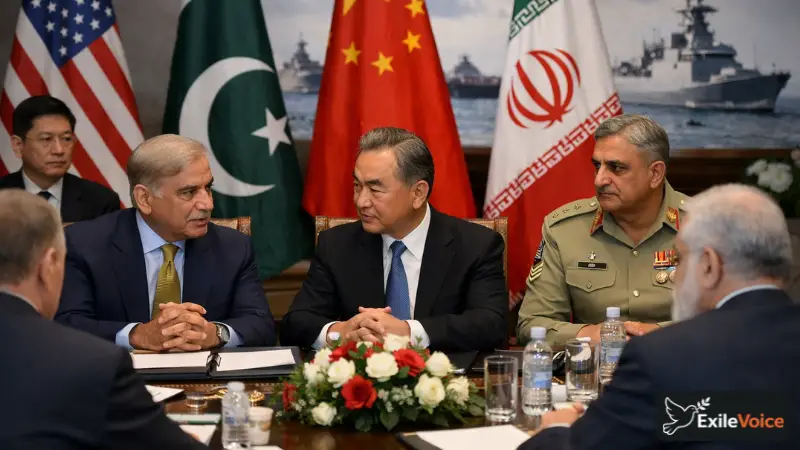
In the wake of the intensifying conflict between the United States and Iran, Pakistan has emerged as a central, albeit controversial, mediator. The current strategy orchestrated by the civil-military leadership in Islamabad is being executed in three distinct phases, each designed to elevate Pakistan’s regional relevance while navigating a treacherous path between two historic rivals.
Phase One began behind closed doors. High-level communication was established between Pakistan’s military leadership and the Trump administration, followed by direct outreach from Prime Minister Shehbaz Sharif to the Iranian presidency. This initial stage was marked by the establishment of a "first deadline" from Donald Trump, providing a narrow window for diplomatic maneuvers. The success of this phase was signaled by a rare public acknowledgment from the White House, marking a pivot from years of diplomatic isolation for Pakistan following the 2021 U.S. withdrawal from Afghanistan.
Phase Two saw Islamabad transitioning from secret channels to public offerings. The Pakistani government formally proposed hosting direct talks between Washington and Tehran. This stage involved intense coordination with regional powers, including Turkey, Saudi Arabia, and Egypt. Despite internal skepticism and external critics labeling the effort as "jugaad" (makeshift), the presence of foreign ministers from these key nations in Islamabad lent weight to the proposal. However, the absence of high-level Iranian representation during these specific meetings initially led some to dismiss the phase as a diplomatic failure.
We are now entering Phase Three: The Great Power Realignment. This phase is characterized by the formal entry of China, Pakistan’s "iron brother," into the mediation framework. Beijing’s public endorsement of Pakistan’s role has fundamentally shifted the dynamics. By aligning with China, Pakistan is no longer acting as a solitary mediator but as part of a broader Eurasian consensus seeking to stabilize the Strait of Hormuz. This phase is critical because it introduces a superpower capable of providing the economic and security guarantees that neither Iran nor the U.S. currently trusts the other to uphold. For Pakistan, the stakes in Phase Three are existential; success could redefine its standing in the international community, while failure could lead to deeper entanglement in a regional war that its fragile economy is ill-equipped to handle.

